The Robotics Dexterity Revolution

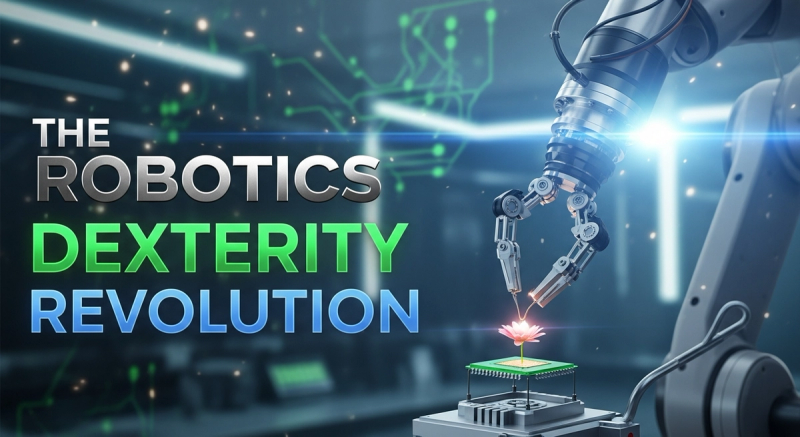
For decades, robots crushed it at strength and repetition but flopped at anything requiring finesse—folding laundry, picking fruit, or assembling intricate electronics. Grippers were either too rigid or too dumb. That changed in late 2025, and 2026 is when dexterous manipulation explodes from labs into warehouses, kitchens, and homes. Powered by recursive AI improvements, new hardware, and massive simulation datasets, robotic hands are finally catching up to human-level skill.
This isn't hype—it's deployment season. From Tesla's Optimus folding shirts to Figure's coffee-making demos, dexterity is the new battleground. Here's why 2026 marks the tipping point.
The Breakthrough Trio: AI + Hardware + Data
Three converging forces unlocked true dexterity:
- Embodiment-Aware Foundation Models: Vision-language-action models (like RT-2, PaLM-E successors, and Grok-inspired stacks) trained on billions of real + simulated trajectories. They generalize to unseen objects without hand-coded rules.
- Soft & Sensor-Rich Hands: GelSight-style tactile sensors, underactuated tendon-driven fingers, and compliant materials give robots "feel." Cost per hand dropped below $5K in volume.
- Simulation at Scale: Tools like NVIDIA Isaac Sim and MuJoCo generate millions of grasping scenarios overnight, closing the sim-to-real gap with domain randomization.
Result? Robots now succeed at >90% on novel object manipulation benchmarks that stumped them at <60% just two years ago.
2026 Dexterity Leaders: Who's Shipping What
| Company/Robot | Key Dexterity Feat | Deployment Status (Q1 2026) | Impact Area |
|---|---|---|---|
| Tesla Optimus Gen 2 | Folds laundry, sorts batteries, pours drinks | Pilot lines in Gigafactories; limited lease program | Manufacturing & home |
| Figure 01 | Full kitchen tasks (chopping, dishwashing) | Commercial pilots with fast-food chains | Food service |
| Agility Digit + Dexterous Hands | Bin picking, tote handling in logistics | Amazon warehouses expanding rollout | Logistics |
| Boston Dynamics Atlas (new electric) | Dynamic manipulation + locomotion | Hyundai plants; R&D showcase | Automotive |
| Covariant RFM-1 | Universal picking for e-commerce | Live in multiple 3PL warehouses | E-commerce fulfillment |
| Ambi Robotics + Dex-Net upgrades | Parcel sorting at 2,000+ items/hour | USPS & logistics partners | Postal & parcel |
Notable mention: Open-source projects like Aloha (mobile manipulator) democratizing dexterity for researchers.
Real-World Impact: Where Dexterity Hits Hardest in 2026
- Logistics & Warehouses: Piece-picking rates double; labor shortages ease without replacing all workers (apocalypse averted).
- Food & Hospitality: Robots prep ingredients safely—addressing chronic staffing gaps.
- Elder Care & Healthcare: Assistive arms feed patients, handle delicate instruments (beyond wearables).
- Manufacturing: Small-batch assembly becomes economical again—reshoring accelerates.
- Home Robots: Early adopters get laundry-folding bots by late 2026 (price ~$20K).
Challenges Remaining: It's Not All Smooth Grasping
- Edge Cases: Fragile items (eggs, glass) still ~75% success; liquids remain tricky.
- Cost vs. Scale: Full dexterous systems $50K–$150K—viable for industry, not yet consumer.
- Safety & Perception: Public wariness lingers; one viral failure could slow adoption (perception matters).
- Ethical Deployment: Guardrails needed for physical world interactions.
The Horizon: 2027 and Beyond
Expect:
- Sub-$10K dexterous arms by 2027.
- Multi-task household robots (clean + cook + organize).
- Human-robot collaboration standards in factories.
The dexterity revolution isn't about replacing hands—it's about augmenting them. 2026 is when robots finally earn their fingers.
Excited or skeptical about dexterous bots in your life? Sound off in the comments.

About the Author
Freya O'Neill
freya-o-neill is a technology journalist specializing in artificial intelligence, software innovation, cybersecurity, and emerging digital trends. She enjoys explaining complex technologies in clear, accessible language for both professionals and everyday readers.
Enjoyed this article?
Check out more content on our blog or follow us on social media.
Browse more articles