Solar Paint: Turning Any Surface into a Power Source

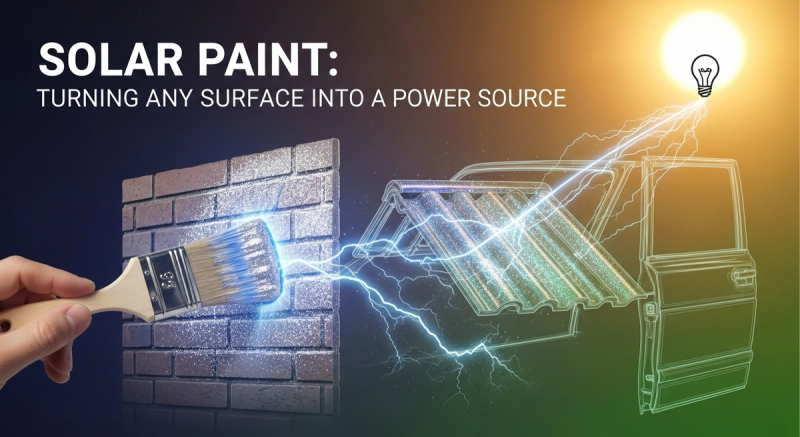
Imagine a world where every surface—your home’s walls, your car’s roof, even your smartphone case—could harness the sun’s energy to power your devices. This isn’t science fiction anymore; it’s the promise of solar paint, a groundbreaking innovation set to revolutionize renewable energy. By transforming ordinary materials into energy generators, solar paint eliminates the need for bulky solar panels and opens doors to endless possibilities for clean, decentralized power. As we dive deeper into this technology, we’ll explore how it works, its real-world applications, and why it could be a game-changer for businesses and individuals alike.
What Exactly Is Solar Paint?
Solar paint, also known as photovoltaic paint or spray-on solar cells, is a liquid mixture of nanomaterials that can be applied to surfaces just like conventional paint. Once dried or cured, it forms a thin film capable of converting sunlight into electricity. Unlike traditional silicon-based solar panels, which require rigid frames and precise installations, solar paint adapts to any substrate—metal, plastic, glass, or even fabric. Its flexibility and lightweight nature make it ideal for integrating into everyday objects without compromising aesthetics or functionality.
The Science Behind the Magic
At the heart of solar paint lies nanotechnology. The paint typically contains quantum dots or perovskite crystals—tiny semiconductor particles that absorb sunlight and release electrons. When sunlight hits these particles, electrons are excited and flow through conductive materials in the paint, generating a direct current (DC). This DC can then be stored in batteries or converted to alternating current (AC) for immediate use. Recent advancements have boosted efficiency, with some prototypes achieving conversion rates of 10-15%—still lower than commercial panels but rapidly improving. Researchers are also experimenting with multi-layer designs to capture different parts of the solar spectrum, potentially pushing efficiency beyond 20% in the coming years.
Why Solar Paint Matters
The potential impact of solar paint extends far beyond novelty. Traditional solar panels, while effective, face limitations: they require large, flat surfaces, complex installations, and high upfront costs. Solar paint dismantles these barriers. For businesses, it offers seamless integration into existing infrastructure, turning buildings, parking lots, and warehouses into power-generating assets. It also aligns with broader sustainability goals, as seen in corporate renewable energy procurement trends for 2026, where companies seek decentralized energy solutions to reduce grid reliance.
Key Advantages Over Traditional Solar
- Universal Application: Can coat curved, irregular, or vertical surfaces where panels can’t go.
- Aesthetically Pleasing: Available in colors and designs, blending into surroundings.
- Cost-Effective: Uses simpler manufacturing processes than silicon wafers, potentially cutting costs by 50%.
- Scalable: Easily applied through spray guns, rollers, or brushes—ideal for large areas.
Real-World Applications and Innovations
Solar paint isn’t just theoretical; prototypes are already making waves. In transportation, companies are testing it on electric vehicles to extend battery range. Imagine a car that recharges while parked under sunlight! For construction, it could turn skyscrapers and homes into self-sufficient power plants. Even consumer electronics benefit—solar-painted phone cases could keep devices charged indefinitely. These innovations are part of a larger shift toward renewable energy innovations reshaping 2026, where flexibility and integration are key.
Business Case Adoption
Forward-thinking businesses are piloting solar paint for rooftops, facades, and industrial equipment. For instance, a factory coated in solar paint could offset energy costs while enhancing its green credentials. Pairing it with energy storage solutions ensures power is available day or night, maximizing ROI. This synergy addresses one of solar’s biggest drawbacks: intermittency.
Challenges on the Horizon
Despite its promise, solar paint faces hurdles. Durability is a concern—exposure to rain, UV radiation, and temperature fluctuations can degrade performance. Current prototypes last 2-5 years, compared to 25+ years for panels. Efficiency also lags behind traditional tech, though AI-driven material science is accelerating breakthroughs. Additionally, scaling production requires solving supply chain issues for rare materials like indium and gallium used in quantum dots.
Economic Viability
While solar paint promises lower costs, mass adoption hinges on subsidies and policy support. Governments offering tax incentives for energy-generating surfaces could tip the scales. As production scales, prices are expected to plummet, making it competitive with fossil fuels. In the long term, it could democratize energy access, enabling remote communities to generate power locally.
The Future: Beyond the Horizon
By 2030, solar paint could become mainstream, integrated into smart cities, vehicles, and wearable tech. Researchers are developing "self-healing" paints to extend lifespan and multi-functional variants that purify air while generating power. It also complements emerging technologies like green hydrogen, where excess solar energy could power electrolyzers to produce clean fuel. The trajectory is clear: solar paint is poised to be a cornerstone of the global energy transition.
Conclusion
Solar paint represents more than an innovation—it’s a paradigm shift in how we think about energy. By transforming every surface into a potential power source, it democratizes renewable energy, empowers businesses, and accelerates sustainability. While challenges remain, rapid advancements in nanotechnology and AI are paving the way for a future where clean energy is ubiquitous. As we embrace this technology, we move closer to a world where energy is abundant, accessible, and harmonious with nature.
What is solar paint made of?
Solar paint typically contains nanomaterials like quantum dots or perovskite crystals suspended in a conductive binder. These components enable sunlight absorption and electricity generation.
How efficient is solar paint compared to solar panels?
Current solar paint prototypes achieve 10-15% efficiency, while commercial panels average 15-22%. However, ongoing research aims to close this gap significantly.
Can solar paint work in cloudy conditions?
Yes, though efficiency drops. Perovskite-based paints can generate power in diffuse light, making them viable in overcast regions.
Is solar paint expensive to apply?
Initial costs are higher than traditional paint but lower than solar panels. Mass production could reduce prices by 50% or more in the next decade.
How long does solar paint last?
Lifespans currently range from 2-5 years, depending on environmental exposure. Future "self-healing" variants may last 10+ years.
Can solar paint be used on any surface?
It adheres to most materials, including metal, plastic, glass, and fabric. Performance may vary based on surface preparation and curvature.
Related Tags

About the Author
Freya O'Neill
freya-o-neill is a technology journalist specializing in artificial intelligence, software innovation, cybersecurity, and emerging digital trends. She enjoys explaining complex technologies in clear, accessible language for both professionals and everyday readers.
Enjoyed this article?
Check out more content on our blog or follow us on social media.
Browse more articles