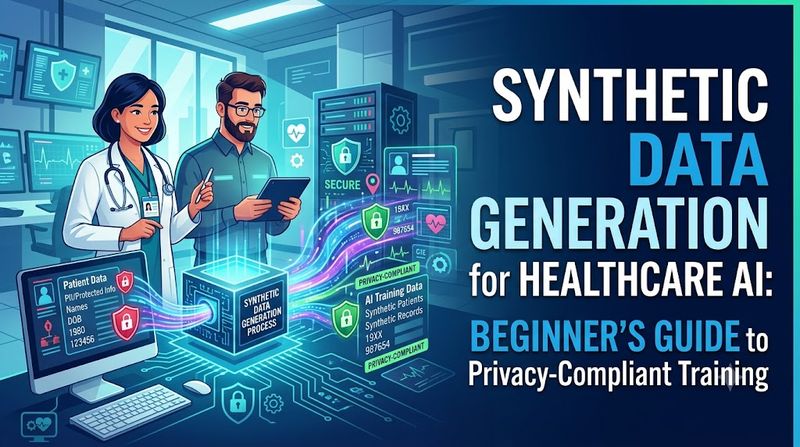
Synthetic Data Generation for Healthcare AI: Beginner’s Guide to Privacy-Compliant Training

Estimated Reading Time: 15 minutes
Target Audience: Healthcare data scientists, ML engineers, compliance officers, and clinical researchers exploring privacy-preserving AI training methods.
Table of Contents
- Why Healthcare AI Needs Synthetic Data
- What Is Synthetic Data? Types and Definitions
- Core Privacy Frameworks: HIPAA, GDPR, and Beyond
- Synthetic Data Generation Techniques
- Step-by-Step Implementation Guide
- Quality Validation: Ensuring Synthetic Data Utility
- Real-World Use Cases and Success Stories
- Common Pitfalls and How to Avoid Them
- Future Trends and Emerging Standards
- Getting Started: Tools and Resources
Why Healthcare AI Needs Synthetic Data
Healthcare AI is stuck in a paradox. The algorithms that could revolutionize diagnosis, drug discovery, and personalized medicine require massive amounts of training data—but the data they need is locked behind some of the strictest privacy regulations on Earth.
The Core Problem: Real patient data is gold for training AI, but using it creates enormous legal, ethical, and security risks. A single HIPAA violation can cost an organization up to $1.5 million per year in penalties, not to mention reputational damage and loss of patient trust.
The Synthetic Solution: Synthetic data—artificially generated datasets that mimic the statistical properties of real data without containing any actual patient information—offers a way out of this deadlock. It enables:
- Cross-institutional collaboration without data sharing
- Rapid prototyping without waiting for IRB approvals
- Balanced datasets for rare diseases where real cases are scarce
- Stress-testing AI models against edge cases that rarely occur naturally
- Public dataset creation for research competitions and reproducible science
Key Insight: Synthetic data isn't just a privacy workaround—it's increasingly a technical necessity. Many healthcare AI projects fail because they can't access enough diverse, representative training data. Synthetic generation can augment scarce datasets and improve model generalization.
What Is Synthetic Data? Types and Definitions
The Fundamental Distinction
Synthetic data is artificially created information that preserves the statistical patterns, correlations, and distributions of real data while containing zero actual records from the source dataset. Think of it as a "digital twin" of your dataset—not a copy, but a statistically faithful recreation.
Three Primary Types of Healthcare Synthetic Data
| Type | Description | Use Case Example |
|---|---|---|
| Fully Synthetic | Every data point is artificially generated; no real patient data included | Public research datasets, algorithm benchmarking |
| Partially Synthetic | Sensitive fields are synthesized while non-sensitive fields remain real | De-identifying specific PHI columns in EHRs |
| Hybrid Synthetic | Combines real and synthetic data to improve utility | Augmenting small clinical trial datasets |
What Synthetic Data Is NOT
- ❌ Anonymized data — Anonymization removes direct identifiers but often leaves re-identification vulnerabilities. Synthetic data creates entirely new records.
- ❌ Pseudonymized data — Pseudonymization replaces identifiers with codes but retains the original data structure. Synthetic data generates completely artificial values.
- ❌ Simple noise addition — Adding random noise to real data doesn't create new information and can destroy statistical utility.
Core Privacy Frameworks: HIPAA, GDPR, and Beyond
HIPAA (Health Insurance Portability and Accountability Act)
HIPAA's Safe Harbor method requires removing 18 specific identifiers (names, dates, SSNs, medical record numbers, etc.). However, Safe Harbor has a critical limitation: it doesn't account for re-identification risk through quasi-identifiers or linkage attacks.
How Synthetic Data Helps: Since synthetic data contains no real patient records, it falls outside HIPAA's definition of Protected Health Information (PHI)—provided the generation process itself doesn't expose real data. This means synthetic datasets can be shared, published, and used for training without HIPAA compliance overhead.
⚠️ Critical Caveat: The process of generating synthetic data must still comply with HIPAA. If you're training a generative model on real PHI, that training environment must be HIPAA-compliant. The output (synthetic data) is what becomes free to use.
GDPR (General Data Protection Regulation)
GDPR's Article 4(1) defines personal data broadly, and Article 5 mandates data minimization. GDPR introduces the concept of "anonymization" as an irreversible process that removes data from regulation scope.
The Synthetic Data Advantage: The UK's Information Commissioner's Office (ICO) and the European Data Protection Board have increasingly recognized that properly generated synthetic data can qualify as anonymous under GDPR, provided:
- The generation model doesn't memorize and reproduce real records
- Re-identification risk is negligible
- The synthetic data doesn't enable inference attacks on the original dataset
Emerging: The HIPAA-GDPR Synthesis Challenge
Healthcare organizations operating globally must satisfy both frameworks. Synthetic data offers a unified compliance path when generated with differential privacy guarantees—a mathematical framework that provides provable privacy bounds.
Synthetic Data Generation Techniques
1. Statistical Methods (The Foundation)
Marginal Distribution Fitting
- Models each variable's distribution independently
- Fast and interpretable but misses inter-variable correlations
- Best for: Simple demographic data, baseline benchmarking
Copula Models
- Captures dependencies between variables using correlation structures
- Preserves marginal distributions while modeling joint behavior
- Best for: Structured EHR data with known correlation patterns
Bayesian Networks
- Probabilistic graphical models representing conditional dependencies
- Excellent for high-dimensional clinical data with complex relationships
- Best for: Multi-modal health records with clear causal structures
2. Deep Learning Generative Models (The State of the Art)
Generative Adversarial Networks (GANs)
GANs use a two-network architecture:
- Generator creates synthetic samples
- Discriminator tries to distinguish real from fake
- Networks compete until the generator produces indistinguishable data
Healthcare Variants:
- MedGAN / ehrGAN — Specialized for discrete EHR data (diagnosis codes, medications)
- TimeGAN — Preserves temporal sequences for longitudinal patient records
- Privacy-GAN — Incorporates differential privacy during training
Pros: High-fidelity, captures complex patterns
Cons: Training instability, mode collapse (generating limited variety), requires large real datasets to train
Variational Autoencoders (VAEs)
VAEs learn a compressed latent representation of data, then sample from this latent space to generate new records.
Healthcare Variants:
- TVAE (Tabular VAE) — Optimized for mixed-type tabular data (continuous + categorical)
- CondVAE — Conditional generation for specific patient subgroups
Pros: More stable training than GANs, built-in regularization
Cons: Often produces blurrier/less sharp distributions than GANs
Diffusion Models
The technology behind DALL-E and Stable Diffusion is now being adapted for tabular data:
- TabDDPM — Diffusion models for tabular healthcare data
- Gradually adds noise to data, then learns to reverse the process
Pros: State-of-the-art quality, strong privacy guarantees
Cons: Computationally expensive, slower generation
3. Differential Privacy (The Mathematical Guarantee)
What It Is: Differential Privacy (DP) is a mathematical framework that ensures the output of a computation (including synthetic data generation) doesn't reveal whether any specific individual was in the dataset.
How It Works: Controlled noise is injected during the generation process. The privacy budget (epsilon, ε) controls the privacy-utility tradeoff:
- ε < 1 — Strong privacy, lower utility
- ε = 1-10 — Moderate privacy, good utility
- ε > 10 — Weak privacy, high utility
DP + Synthetic Data:
- DP-SGD — Differentially private stochastic gradient descent for training GANs/VAEs
- PATE-GAN — Private Aggregation of Teacher Ensembles for GAN training
- MST (Minimum Spanning Tree) — DP-compliant graphical models
Practical Recommendation: For healthcare applications, aim for ε ≤ 3 with a privacy budget allocation strategy. Always document your ε value in research publications—transparency builds trust.
Step-by-Step Implementation Guide
Phase 1: Preparation and Scoping (Week 1-2)
Step 1: Define Your Use Case
- What AI model will you train? (Classification, regression, segmentation?)
- What data modalities? (Tabular EHR, medical imaging, clinical notes, genomics?)
- What's your privacy risk tolerance? (Internal use vs. public release?)
Step 2: Conduct a Data Inventory
Map your source data:
Patient Demographics → Age, Gender, Race, BMI
Clinical History → ICD-10 codes, medications, procedures
Laboratory Values → Test results, reference ranges
Imaging Metadata → Modality, body part, acquisition parameters
Temporal Data → Admission dates, length of stay, readmission flags
Step 3: Privacy Risk Assessment
- Identify direct identifiers (remove before synthesis)
- Map quasi-identifiers (zip code, birth date, rare diagnoses)
- Assess re-identification risk using tools like:
- k-anonymity (each record is indistinguishable from k-1 others)
- l-diversity (sensitive attributes have l distinct values)
- t-closeness (distribution of sensitive attributes matches overall distribution)
Phase 2: Tool Selection and Setup (Week 3-4)
| Tool/Library | Best For | Language | DP Support |
|---|---|---|---|
| Synthetic Data Vault (SDV) | General tabular data | Python | Yes (via CTGAN/TVAE) |
| MOSTLY AI | Enterprise healthcare | SaaS/API | Yes |
| Gretel.ai | Cloud-based synthesis | Python/SaaS | Yes (strong) |
| YData | Data-centric AI workflows | Python | Yes |
| Synthea | Synthetic patient populations | Java | N/A (rule-based) |
| Simulacrum | Cancer registry data | R | Limited |
Recommended Stack for Beginners:
- SDV (open-source, well-documented) + Synthea (for patient populations)
- Start with CTGAN for mixed-type tabular data
- Add differential privacy via Opacus (PyTorch) or TensorFlow Privacy
Phase 3: Generation and Validation (Week 5-8)
Step 4: Train Your Generative Model
# Example using SDV with CTGAN
from sdv.single_table import CTGANSynthesizer
from sdv.metadata import SingleTableMetadata

# Load and prepare your real data
metadata = SingleTableMetadata()
metadata.detect_from_dataframe(real_data)

# Initialize synthesizer with differential privacy considerations
synthesizer = CTGANSynthesizer(
    metadata=metadata,
    epochs=300,
    batch_size=500,
    verbose=True
)

# Train (ensure this happens in HIPAA-compliant environment)
synthesizer.fit(real_data)

# Generate synthetic dataset
synthetic_data = synthesizer.sample(num_rows=10000)
Step 5: Quality Validation (See detailed section below)
Step 6: Privacy Auditing
- Membership Inference Attacks — Can an attacker determine if a specific person was in the training set?
- Attribute Inference Attacks — Can sensitive attributes be reconstructed?
- Model Inversion Attacks — Can the model regenerate training examples?
Use tools like:
- ML Privacy Meter (membership inference testing)
- TensorFlow Privacy Audits
- Custom linkage attacks against public datasets
Phase 4: Deployment and Monitoring (Ongoing)
Step 7: Documentation
Create a Synthetic Data Card documenting:
- Source data description
- Generation method and parameters
- Privacy guarantees (ε value, methods used)
- Validation metrics
- Known limitations and bias assessments
Step 8: Continuous Monitoring
- Retrain models as source data evolves
- Monitor for data drift between synthetic and real distributions
- Audit for emerging re-identification techniques
Quality Validation: Ensuring Synthetic Data Utility
Three Pillars of Validation
| Pillar | Question | Metrics |
|---|---|---|
| Fidelity | Does it statistically match real data? | Distribution similarity, correlation preservation |
| Utility | Does it train effective AI models? | Downstream task performance comparison |
| Privacy | Does it protect real patients? | Membership inference resistance, uniqueness scores |
Fidelity Metrics
1. Statistical Similarity
- Kolmogorov-Smirnov test — Compare continuous variable distributions
- Chi-squared test — Compare categorical variable distributions
- Correlation matrix distance — Measure pairwise correlation preservation
2. Distribution Overlap
- Use Wasserstein distance (Earth Mover's Distance) to quantify distribution similarity
- Lower distance = better fidelity
Utility Metrics
The Gold Standard: Train your target AI model on synthetic data, test on real held-out data, and compare performance to a model trained on real data.
Performance Gap = |AUC_synthetic - AUC_real| / AUC_real

Acceptable threshold: < 5% performance degradation for most use cases
Cross-Validation Strategy:
- Train Model A on real data → Test on real test set → Get baseline
- Train Model B on synthetic data → Test on same real test set → Compare
- If performance gap is acceptable, synthetic data is utility-preserving
Privacy Metrics
1. Nearest Neighbor Distance Ratio
- For each synthetic record, find its nearest neighbor in the real dataset
- If distances are too small, the synthetic record may be memorized
2. Membership Inference Attack Success Rate
- Train an attack model to distinguish training set members from non-members
- Lower success rate = better privacy
3. Uniqueness Score
- Percentage of synthetic records that are unique in the dataset
- Higher uniqueness (with good fidelity) suggests less memorization
Real-World Use Cases and Success Stories
Use Case 1: Rare Disease Research
Challenge: Only 200 patients globally have a specific genetic disorder—not enough to train a diagnostic AI.
Solution: Generate 10,000 synthetic patient profiles preserving the disease's clinical phenotype distribution.
Outcome: Researchers published a diagnostic model without exposing the small patient cohort.
Use Case 2: Hospital Readmission Prediction
Challenge: A health system wants to share readmission risk models with partner hospitals but can't share patient data.
Solution: Generate synthetic EHRs matching their population's demographics, comorbidities, and readmission patterns.
Outcome: Partners can validate and adapt the model locally using privacy-safe synthetic data.
Use Case 3: Medical Imaging Augmentation
Challenge: Training data for rare pathologies (e.g., specific tumor types) is limited.
Solution: Use diffusion models to generate synthetic MRI/CT scans with pathology annotations.
Outcome: Improved segmentation model performance by 12% on real test sets through data augmentation.
Use Case 4: Algorithm Fairness Auditing
Challenge: Assessing whether an AI model performs equitably across demographic groups requires access to sensitive attributes.
Solution: Generate synthetic datasets with known demographic distributions to stress-test for bias.
Outcome: Identified performance disparities before deployment, enabling corrective training.
Common Pitfalls and How to Avoid Them
🚫 Pitfall 1: "Synthetic Data Is Automatically Private"
Reality: Poorly generated synthetic data can memorize and reproduce real records. GANs without privacy constraints have been shown to regenerate exact training examples.
Fix: Always apply differential privacy and conduct membership inference testing.
🚫 Pitfall 2: "Higher Fidelity = Better Data"
Reality: Perfect fidelity often means perfect memorization. The best synthetic data has slightly lower fidelity but strong privacy guarantees.
Fix: Optimize for the fidelity-privacy-utility frontier, not fidelity alone.
🚫 Pitfall 3: "One Synthetic Dataset Fits All"
Reality: A synthetic dataset optimized for training a diagnostic model may fail for prognostic models.
Fix: Generate task-specific synthetic data or validate across multiple downstream tasks.
🚫 Pitfall 4: Ignoring Temporal Integrity
Reality: Healthcare data is longitudinal. Shuffling timestamps destroys clinical meaning.
Fix: Use temporal generative models (TimeGAN, RNN-based VAEs) and preserve visit sequences.
🚫 Pitfall 5: Underestimating Regulatory Scrutiny
Reality: Regulators are increasingly asking for evidence that synthetic data is truly non-identifiable.
Fix: Document your generation process, privacy proofs, and validation results. Prepare an audit trail.
🚫 Pitfall 6: Bias Amplification
Reality: If your real data has demographic biases, synthetic data can amplify them.
Fix: Audit synthetic data for fairness metrics. Use conditional generation to ensure demographic representation.
Future Trends and Emerging Standards
1. Regulatory Sandboxes for Synthetic Data
The FDA and EMA are exploring synthetic data regulatory pathways that would allow AI models trained primarily on synthetic data to enter accelerated review tracks, provided the synthesis methodology is pre-approved.
2. Federated Synthetic Data Generation
Instead of centralizing real data to generate synthetic data, federated learning + synthetic generation allows institutions to collaboratively train generative models without sharing raw data. Each hospital trains a local generator; only model updates (not data) are shared.
3. Multimodal Synthetic Data
Next-generation healthcare AI requires combining EHRs, imaging, genomics, and clinical notes. Multimodal generative models (like those being developed by NVIDIA and Google Health) will generate synchronized synthetic data across all modalities.
4. Synthetic Data Quality Standards
Organizations like IEEE and HL7 are developing standardized evaluation frameworks for healthcare synthetic data, including:
- Minimum fidelity thresholds
- Privacy guarantee documentation formats
- Utility benchmarking protocols
5. Synthetic Data Marketplaces
Emerging platforms are creating licensed synthetic healthcare datasets—pre-validated, privacy-guaranteed datasets that researchers can purchase without IRB delays. This could democratize access to high-quality training data.
Getting Started: Tools and Resources
Open-Source Libraries
| Resource | Link | Description |
|---|---|---|
| SDV (Synthetic Data Vault) | sdv.dev | Comprehensive Python library for tabular, relational, and time-series synthesis |
| Synthea | synthetichealth.github.io/synthea | Generates synthetic patient populations and EHRs |
| TensorFlow Privacy | github.com/tensorflow/privacy | Differential privacy for TensorFlow models |
| Opacus | opacus.ai | Differential privacy for PyTorch |
| YData-Synthetic | github.com/ydataai/ydata-synthetic | Streamlined synthetic data generation |
Enterprise Platforms
- MOSTLY AI — Enterprise-grade with strong healthcare compliance features
- Gretel.ai — Cloud-native with advanced privacy guarantees
- Hazy — Focus on high-utility tabular synthesis for regulated industries
Learning Resources
- "The Synthetic Data Vault" — MIT research papers and documentation
- NIST Privacy Framework — Guidelines for de-identification and risk management
- IEEE P7002 — Standard for data privacy processing
Conclusion: The Privacy-Compliant Path Forward
Synthetic data generation isn't just a technical workaround for privacy regulations—it's becoming a foundational capability for healthcare AI development. By mastering these techniques, organizations can:
- ✅ Accelerate AI development without compliance bottlenecks
- ✅ Enable collaboration across institutional boundaries
- ✅ Improve model robustness through controlled data augmentation
- ✅ Demonstrate ethical AI commitment to patients and regulators
Your Next Steps:
- Start small: Pick one non-critical dataset and experiment with SDV or Synthea
- Validate rigorously: Never assume privacy—always test it
- Document everything: Build audit trails before regulators ask for them
- Engage legal early: Bring compliance teams into the conversation from day one
- Iterate: Synthetic data generation is as much art as science—expect refinement cycles
The future of healthcare AI depends on our ability to learn from data without exposing the individuals behind it. Synthetic data generation is the bridge between privacy protection and medical innovation. The organizations that master it today will lead the healthcare AI revolution tomorrow.
Have questions about implementing synthetic data in your healthcare AI pipeline? The field is evolving rapidly—stay current with the latest privacy techniques and validation methodologies.
Related Articles You Might Enjoy:
- Differential Privacy: A Technical Primer for Healthcare Teams
- Building HIPAA-Compliant ML Pipelines: A Complete Checklist
- Federated Learning in Healthcare: Multi-Site AI Without Data Sharing
- Bias Detection in Medical AI: Tools and Techniques
Related Tags

About the Author
Freya O'Neill
freya-o-neill is a technology journalist specializing in artificial intelligence, software innovation, cybersecurity, and emerging digital trends. She enjoys explaining complex technologies in clear, accessible language for both professionals and everyday readers.
Enjoyed this article?
Check out more content on our blog or follow us on social media.
Browse more articles