How to Build Multi-Agent AI Workflows for Small Business Supply Chain Disruption Prediction

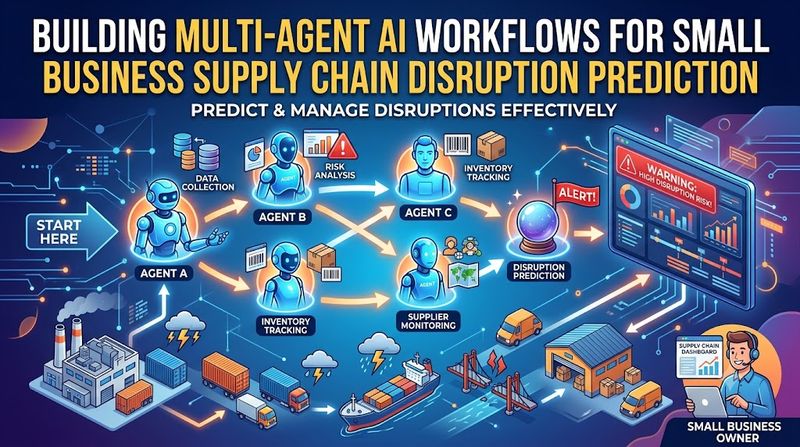
A practical, step-by-step guide to architecting affordable multi-agent AI systems that predict supply chain disruptions before they impact your small business operations.
Why Multi-Agent AI Is the Future of Supply Chain Resilience
Supply chain disruption is no longer an exception—it is the new normal. In 2026, 78% of supply chain leaders anticipate disruptions to intensify over the next two years, yet only 25% feel prepared to handle them. For small businesses with limited buffers, a single missed shipment or supplier failure can mean the difference between profit and loss.
Traditional supply chain management relies on reactive firefighting: spreadsheets, manual monitoring, and human intuition. Predictive analytics improved this by telling you what might happen. But AI agents go further—they perceive conditions, reason through options, and execute actions autonomously. When a supplier delays a shipment, traditional software logs the delay. An AI agent detects it, evaluates alternatives, rebooks with another carrier, adjusts downstream schedules, and notifies affected customers automatically.
Gartner projects that by 2031, 60% of supply chain disruptions will be resolved without human involvement. The organizations building toward that capability today are deploying AI agents for specific, bounded disruption scenarios and expanding as confidence grows. For small businesses, the question is no longer whether to adopt AI agents, but how to build them affordably and effectively.
The answer lies in multi-agent workflows: coordinated systems of specialized AI agents that each handle a distinct task—monitoring, prediction, risk assessment, planning, and communication—working together under an orchestrator to create a "self-healing" supply chain.
What Is a Multi-Agent AI Workflow?
A multi-agent AI workflow is a system where multiple specialized AI agents collaborate to solve complex problems that no single agent could handle alone. Unlike a monolithic AI model that tries to do everything, a multi-agent system distributes intelligence across specialized roles:
- Monitoring Agents ingest and normalize real-time data from dozens of sources.
- Prediction Agents run machine learning models to forecast demand, delays, and disruptions.
- Risk Assessment Agents evaluate supplier health, financial stability, and geopolitical threats.
- Planning Agents generate contingency plans: rerouting, reordering, activating backup suppliers.
- Communication Agents notify stakeholders, update customers, and coordinate with suppliers.
- Orchestrator Agent coordinates the workflow, delegates tasks, and escalates exceptions to humans.
This architecture mirrors how effective supply chain teams already work—but at machine speed, 24/7, without fatigue or oversight gaps. For small businesses, it levels the playing field against larger competitors with dedicated risk management departments.
The key distinction from traditional automation is adaptability. RPA (robotic process automation) follows fixed rules. When conditions change, RPA breaks. AI agents perceive changes, reason through new options, and adapt their actions in real time. This is the difference between a conveyor belt and a supply chain strategist.
The Small-Business Multi-Agent Architecture
For small businesses, the architecture must balance sophistication with affordability. You do not need Unilever's 26-data-source integration on day one. You need a modular system that starts with your highest-friction workflow and expands incrementally.
Layer 1: The Data Foundation
Every agent needs clean, connected data. For small businesses, prioritize these sources:
- Internal systems: ERP (QuickBooks, NetSuite, SAP Business One), WMS, order management
- Logistics data: Carrier APIs (FedEx, UPS, DHL), TMS feeds, port congestion trackers
- External signals: Weather APIs, geopolitical news feeds, commodity price indices
- Supplier data: Financial health scores, delivery history, quality incident logs
Layer 2: The Agent Ecosystem
Start with three core agents, then expand:
1. The Monitoring Agent
This agent acts as your 24/7 supply chain radar. It ingests data from all connected sources, normalizes formats, and detects anomalies in real time. For example, it flags when a supplier's on-time delivery rate drops below 85%, when a shipping lane shows unusual congestion, or when commodity prices spike beyond a threshold.
2. The Prediction Agent
This agent runs lightweight machine learning models on historical and real-time data to forecast disruptions. It does not need deep learning infrastructure. Even simple time-series models (ARIMA, Prophet) or gradient-boosted trees (XGBoost, LightGBM) trained on your specific data outperform generic dashboards. The agent outputs risk scores and confidence intervals: "72% probability of 3-day delay on SKU-2847 within 14 days."
3. The Response Agent
This agent translates predictions into action. When the prediction agent flags a high-risk scenario, the response agent evaluates options: activate a backup supplier, increase safety stock, reroute shipments, or negotiate expedited freight. It presents recommendations to a human decision-maker for approval, learning from each decision to improve future recommendations.
Layer 3: The Orchestrator
The orchestrator is the "brain" that coordinates agent collaboration. It receives alerts from the monitoring agent, triggers the prediction agent for deeper analysis, invokes the response agent when thresholds are breached, and escalates to humans when confidence is low or stakes are high. For small businesses, this can be implemented using workflow automation tools like n8n, Make (Integromat), or LangChain orchestration frameworks.
Layer 4: Human-in-the-Loop
Despite increasing autonomy, the most successful implementations augment humans rather than replace them. The orchestrator escalates novel or high-stakes decisions to a human reviewer. This "human-on-the-loop" model—where AI handles routine decisions and humans supervise exceptions—builds trust and ensures compliance. Gartner research confirms that organizations investing in explainable AI and human-in-the-loop governance see faster adoption and higher ROI.
Step-by-Step: Building Your First Multi-Agent Workflow
Step 1: Identify Your Highest-Friction Workflow
Do not try to automate everything. Pick one workflow with high transaction volume, structured decision logic, and measurable exception costs. Common starting points for small businesses:
- Demand forecasting: If stockouts or excess inventory cost you money monthly
- Supplier delay response: If you spend hours manually rerouting when a shipment is delayed
- Inventory rebalancing: If you frequently transfer stock between locations
- Customer communication: If "Where's my order?" consumes your team's time
Step 2: Map Your Data Sources
For your chosen workflow, identify the minimum viable data:
- What data do you already have in your ERP or WMS?
- What external data is available via free or low-cost APIs?
- What data gaps exist, and can you fill them with manual inputs or simple scrapers?
Example: For supplier delay prediction, you need historical delivery data (from your ERP), current shipment tracking (from carrier APIs), and external risk signals (weather, port congestion). Start with what you have. You can add sophistication later.
Step 3: Build the Monitoring Agent
The monitoring agent is your data ingestion layer. Use a workflow automation tool (n8n, Make, or Zapier) to:
- Pull data from your ERP via API or scheduled CSV export
- Query carrier APIs for shipment status updates
- Fetch weather and news data from free sources (OpenWeatherMap, GDELT)
- Normalize all data into a common format (JSON or a simple database)
- Apply basic anomaly detection rules (e.g., flag shipments delayed >24 hours, flag supplier OTD drops >10%)
This agent does not need AI yet. Rule-based thresholds are sufficient to start and provide immediate value.
Step 4: Train the Prediction Agent
Once you have 6-12 months of normalized data, train a lightweight prediction model:
- Export historical data: shipment dates, actual vs. promised delivery, external conditions at time of shipment
- Label disruptions: which shipments were delayed and by how much
- Train a simple model using Python (scikit-learn, XGBoost) or no-code ML platforms (obviously.ai, Akkio)
- Deploy the model as an API endpoint that the orchestrator can call
- Start with predicting binary outcomes (delay/no delay) before moving to regression (days delayed)
Even a model with 65-70% accuracy provides more signal than manual intuition. Unilever improved forecast accuracy from 67% to 92% by adding external data sources—your baseline may be lower, giving you more room to improve.
Step 5: Create the Response Agent
The response agent translates predictions into actionable recommendations. Design decision trees for common scenarios:
- Scenario: Supplier A delay predicted with 80% confidence in 7 days
- Option 1: Expedite existing order (cost: $X, time saved: Y days)
- Option 2: Activate backup Supplier B (cost: $Z, quality risk: low)
- Option 3: Increase safety stock by 20% (cost: $W, stockout risk: eliminated)
The agent presents these options with cost-benefit analysis to a human decision-maker. Over time, as the agent learns which options you typically choose, it can pre-select recommendations and only escalate exceptions.
Step 6: Connect the Orchestrator
The orchestrator ties everything together using a workflow engine:
- Monitoring agent detects anomaly → triggers orchestrator
- Orchestrator calls prediction agent for risk score
- If risk score > threshold, orchestrator calls response agent for options
- Response agent presents options to human via email/Slack/dashboard
- Human approves/rejects → orchestrator logs decision and triggers action APIs
- Feedback loop: actual outcome feeds back to prediction agent for retraining
Step 7: Add the Communication Agent
Once the core workflow is stable, add a communication agent that:
- Proactively notifies customers of predicted delays with updated ETAs
- Alerts suppliers when their performance triggers risk thresholds
- Generates daily/weekly resilience reports for leadership
This agent can be built using no-code AI chatbot platforms or simple email automation triggered by the orchestrator.
Tools and Platforms for Small Business Budgets
Enterprise AI platforms cost hundreds of thousands of dollars. Small businesses need modular, affordable tools that integrate well. Here is a practical stack:
Orchestration & Workflow
| Tool | Best For | Cost |
|---|---|---|
| n8n | Open-source workflow automation, self-hosted | Free (self-hosted) / $20/mo cloud |
| Make (Integromat) | Visual workflow builder with 1,500+ app integrations | Free tier / $9/mo+ |
| LangChain / LangGraph | Python-based agent orchestration for technical teams | Open source |
Data & Monitoring
| Tool | Best For | Cost |
|---|---|---|
| Supabase / PostgreSQL | Centralized data store for agent inputs | Free tier / $25/mo+ |
| OpenWeatherMap API | Weather disruption signals | Free tier (1,000 calls/day) |
| GDELT Project | Global news and event monitoring | Free |
| MarineTraffic / VesselFinder | Maritime shipping visibility | Free tier available |
Machine Learning
| Tool | Best For | Cost |
|---|---|---|
| scikit-learn / XGBoost | Custom prediction models (Python) | Open source |
| Obviously AI | No-code ML prediction platform | $399/mo |
| Akkio | No-code ML for tabular data | $49/mo+ |
| Hugging Face Inference API | Pre-trained NLP models for news analysis | Free tier available |
Communication & Alerts
| Tool | Best For | Cost |
|---|---|---|
| Slack API | Internal team alerts and approvals | Free tier |
| SendGrid / Mailgun | Automated customer notifications | Free tier (100 emails/day) |
| Twilio | SMS alerts for critical disruptions | Pay-as-you-go |
Total estimated starting cost: $0-100/month for a basic monitoring + prediction workflow using open-source and free-tier tools. Scale costs only as you add agents and data volume.
Essential Data Sources for Disruption Prediction
The quality of your predictions depends on the breadth and freshness of your data. Small businesses should prioritize these categories:
1. Internal Operational Data
- Historical orders and deliveries: SKU-level demand patterns, seasonal trends
- Supplier performance metrics: On-time delivery rate, quality defect rate, lead time variance
- Inventory levels: Stock-on-hand, safety stock, reorder points
- Production schedules: Capacity utilization, changeover times
2. Logistics & Transportation Data
- Carrier tracking APIs: Real-time shipment location and status
- Port and airport congestion indices: Dwell time, vessel count, delay averages
- Freight rate indices: Baltic Dry Index, container freight rates
- Traffic and road conditions: Last-mile delivery risk signals
3. External Risk Signals
- Weather data: Hurricanes, floods, extreme temperatures affecting routes and facilities
- Geopolitical events: Trade policy changes, sanctions, labor strikes
- Financial health: Supplier credit scores, bankruptcy filings, earnings reports
- Commodity prices: Raw material cost fluctuations affecting supplier viability
- News sentiment: NLP-processed news about your suppliers, regions, and industries
4. Demand Signals
- Point-of-sale data: Real-time sales velocity
- Web analytics: Search trends, cart abandonment, product page views
- Social media sentiment: Consumer interest shifts
- Promotional calendars: Marketing campaigns affecting demand spikes
Start with 3-5 data sources that are readily accessible via API or export. The monitoring agent can add sources incrementally. Remember: a model trained on 5 clean, relevant data sources outperforms one trained on 50 noisy, irrelevant sources.
Implementation Roadmap: 90-Day Plan
Days 1-30: Foundation & Monitoring
- Audit current supply chain data and identify gaps
- Set up centralized data store (Supabase/PostgreSQL)
- Build Monitoring Agent: connect ERP, carrier APIs, and 2-3 external data sources
- Define anomaly thresholds and alert rules
- Create dashboard for real-time visibility
- Deliverable: Live monitoring system with basic alerts
Days 31-60: Prediction & Risk Scoring
- Export 6-12 months of historical data for model training
- Build first prediction model (delay probability for top 5 suppliers)
- Integrate prediction API into orchestrator workflow
- Implement risk scoring dashboard (supplier health, route risk)
- Run model in "shadow mode" (predictions logged but not acted upon) for 2 weeks
- Validate accuracy against actual outcomes
- Deliverable: Prediction agent running with validated accuracy metrics
Days 61-90: Response Automation & Communication
- Build Response Agent with decision trees for top 3 disruption scenarios
- Implement human-in-the-loop approval workflow
- Add Communication Agent for proactive customer/supplier notifications
- Run end-to-end pilot with one product category or supplier
- Measure KPIs: mean time to detect, mean time to respond, forecast accuracy
- Document lessons learned and plan expansion
- Deliverable: End-to-end multi-agent workflow handling one disruption type autonomously
After 90 days, expand incrementally: add suppliers, add disruption types, add data sources, and gradually reduce human oversight for routine decisions.
Governance, Trust, and Human-in-the-Loop Design
AI agents in supply chain management must operate with clear boundaries. A wrong procurement decision or missed compliance requirement carries real financial and legal consequences. Every small business deploying multi-agent workflows needs:
1. Decision Confidence Thresholds
Define when an agent acts autonomously versus escalating to a human:
- Green zone (autonomous): Routine reordering, standard route selection, status updates. Confidence >85%.
- Yellow zone (recommendation): Supplier switches, expedited freight, inventory transfers. Confidence 60-85%. Human approval required.
- Red zone (escalation): Contract changes, new supplier onboarding, regulatory compliance issues. Confidence <60% or high financial impact. Human decision required.
2. Audit Trails
Log every agent decision: what data was ingested, what model was used, what prediction was made, what action was taken, and who approved it. This is essential for:
- Post-disruption root cause analysis
- Regulatory compliance (if applicable to your industry)
- Continuous improvement of agent performance
3. Explainability
Agents must explain why they made a recommendation. Use interpretable models (decision trees, linear models, SHAP values for complex models) so your team understands the reasoning. Unexplained "black box" recommendations erode trust and slow adoption.
4. Rollback Capabilities
Build automated rollback triggers. If an agent's action produces an unexpected result (e.g., rerouting increases cost by >50%), the system should automatically revert and escalate.
5. Cross-Functional Governance
Form a small steering committee including operations, procurement, finance, and IT. Even in a small business, this ensures agent objectives align with business strategy and risk appetite.
Measuring ROI and Business Impact
Track these metrics across three dimensions to demonstrate value:
Financial Impact
- Inventory cost reduction: Excess inventory eliminated, stockout costs avoided
- Logistics cost savings: Reduced expedited freight, optimized routing
- Procurement efficiency: Time saved on supplier evaluation and reordering
- Revenue protection: Sales not lost due to stockouts or delivery failures
Benchmark: Early adopters of AI in supply chain report 15% overall supply chain cost reduction and 25-30% higher process efficiency.
Operational Efficiency
- Mean time to detect (MTTD): How quickly disruptions are identified
- Mean time to respond (MTTR): How quickly actions are taken after detection
- Forecast accuracy: Improvement in demand and delay predictions
- Automation rate: Percentage of routine decisions handled without human intervention
Benchmark: AI agents eliminate 60-80% of routine task handling time across supply chain functions.
Strategic Value
- Supplier resilience score: Improved diversification and backup activation
- Customer satisfaction: Fewer missed deliveries, proactive communication
- Risk mitigation: Disruptions prevented vs. reacted to
- Team capacity: Hours freed for strategic work vs. firefighting
Set baseline measurements before deployment. Compare monthly. Share wins internally to build organizational confidence for expanding the system.
Common Mistakes to Avoid
Mistake 1: Confusing AI Categories
Predictive analytics, RPA, and AI agents solve different problems. Do not buy a forecasting tool when you need autonomous exception handling. Define the problem before evaluating solutions.
Mistake 2: Deploying Without Data Integration
AI agents on disconnected, siloed data produce unreliable outputs. Unify the data estate for your target workflow before deploying agents at scale. One clean data pipeline beats ten messy ones.
Mistake 3: Trying to Automate Everything Simultaneously
A single procurement agent delivering results in four weeks builds more organizational confidence than a twelve-month enterprise-wide initiative that has not launched yet. Start narrow, prove value, expand.
Mistake 4: Ignoring Change Management
84% of companies have not redesigned jobs around AI capabilities, yet 36% expect at least 10% of jobs to be fully automated within a year. That gap creates organizational friction. Position AI as augmentation, not replacement. Retrain teams to supervise and optimize agents rather than fearing them.
Mistake 5: Skipping Governance
Every AI agent needs audit trails, decision explanations, and escalation rules. Supply chains involve regulatory compliance, contractual obligations, and financial liability. Governance is not bureaucracy—it is risk management.
Mistake 6: Expecting Perfection on Day One
Your first prediction model will be wrong 30-40% of the time. That is still better than no prediction at all. AI agents improve their accuracy over time as they learn from operational outcomes. Embrace the feedback loop.
Conclusion: Start Small, Scale Smart
Multi-agent AI workflows are no longer the exclusive domain of Fortune 500 companies. The same principles that let Unilever cut $330 million in excess inventory and Novartis reduce procurement review from 5 days to 16 minutes are accessible to small businesses using affordable, modular tools.
The key is to start with one high-friction workflow, build a minimum viable multi-agent system, and expand incrementally. Begin with a Monitoring Agent that gives you visibility you do not have today. Add a Prediction Agent that turns that visibility into foresight. Layer on a Response Agent that turns foresight into action. Let an Orchestrator coordinate the workflow, and keep humans in the loop for high-stakes decisions.
The gap between supply chain leaders and laggards is structural and widening. In 2026, 65% of supply chain organizations have already implemented AI in at least one area of risk management. The organizations building toward full autonomy are deploying AI agents for specific, bounded disruption scenarios and expanding as confidence grows.
For small businesses, the competitive advantage is not in building the most sophisticated AI—it is in being faster to deploy, more agile in adapting, and smarter about where automation delivers the highest return. Every quarter of manual exception handling and reactive planning is structural efficiency you are leaving on the table while competitors compound theirs.
Start with your highest-friction workflow. Deploy an agent. Measure the results. Scale what works. The future of supply chain resilience is not a dashboard that tells you what happened. It is a multi-agent system that prevents disruptions before they occur.
Quick-Start Checklist
- ☐ Identify your highest-friction supply chain workflow
- ☐ Audit existing data sources (ERP, carrier APIs, external feeds)
- ☐ Set up centralized data store (Supabase/PostgreSQL)
- ☐ Build Monitoring Agent with 3-5 data sources and anomaly rules
- ☐ Train first prediction model on 6-12 months of historical data
- ☐ Design decision trees for top 3 disruption scenarios
- ☐ Implement human-in-the-loop approval workflow
- ☐ Add Communication Agent for proactive notifications
- ☐ Run 30-day pilot with one product category
- ☐ Measure MTTD, MTTR, forecast accuracy, and cost impact
- ☐ Document lessons learned and plan 90-day expansion
Related Tags

About the Author
Freya O'Neill
freya-o-neill is a technology journalist specializing in artificial intelligence, software innovation, cybersecurity, and emerging digital trends. She enjoys explaining complex technologies in clear, accessible language for both professionals and everyday readers.
Enjoyed this article?
Check out more content on our blog or follow us on social media.
Browse more articles