EU AI Act Compliance Tooling: Step-by-Step Guide for SMEs Before August 2026 Deadline

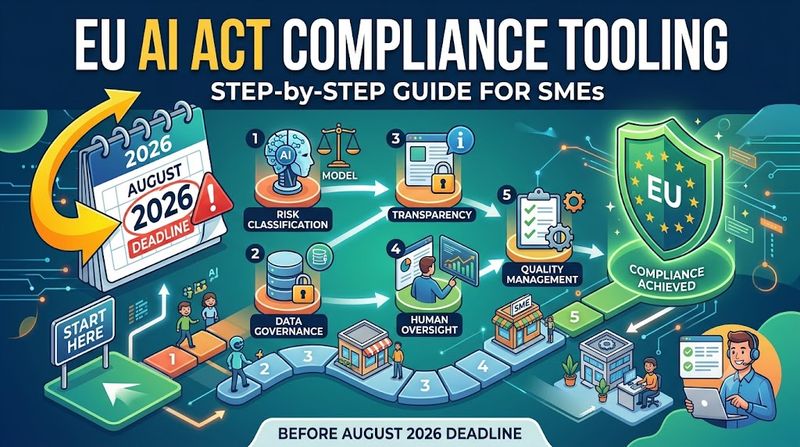
Key takeaway: The August 2, 2026 deadline for deployer transparency obligations under Article 50 is legally binding and fast approaching. While high-risk system deadlines have been extended to December 2027, SMEs must act now on chatbot disclosure, AI-generated content marking, and prohibited practices compliance—or face fines up to €35 million or 7% of global turnover.
What Actually Happens on August 2, 2026?
The EU AI Act timeline has shifted significantly in 2026, but the changes are not uniform. Understanding which deadlines moved and which did not is the first step for any SME compliance strategy.
On May 7, 2026, the Council and European Parliament reached a political agreement on the Digital Omnibus package, which proposes extending several AI Act deadlines. However, until the Omnibus is formally adopted and published in the Official Journal, the original August 2, 2026 date remains legally binding. Organizations that pause compliance work based on anticipated delays are taking a significant legal risk.
Deadlines That Remained Unchanged
- August 2, 2026: Deployer transparency obligations under Article 50 (chatbot disclosure, deepfake labeling)
- December 2, 2026: Provider marking of AI-generated content; new prohibition on "nudifier" applications and AI-generated child sexual abuse material
- February 2, 2025: Prohibited practices already in force (social scoring, subliminal manipulation, real-time biometric remote identification in public spaces)
Deadlines That Were Extended
- December 2, 2027: High-risk AI system obligations under Annex III (stand-alone high-risk systems)
- August 2, 2028: High-risk AI system obligations under Annex I (AI embedded in regulated products)
The critical insight for SMEs: the extended deadlines for high-risk systems do not mean you can wait. The transparency obligations taking effect in August 2026 apply to all AI systems interacting with users in the EU, regardless of risk classification. If your website uses a chatbot, if your marketing includes AI-generated images, or if your product creates synthetic content, August 2026 is your hard deadline.
SME-Specific Obligations Under the EU AI Act
The EU AI Act includes specific provisions designed to reduce the compliance burden on small and medium enterprises. The Digital Omnibus extends these simplifications to small mid-cap companies as well, reflecting the EU's stated goal of reducing compliance burden by 25% overall and 35% for SMEs by 2029.
SME Protections and Simplifications
- Reduced penalties: When fines are calculated, SMEs are subject to the lower of the fixed amount or percentage of turnover, with specific protections for micro-enterprises
- Simplified conformity assessments: SMEs can leverage streamlined processes for demonstrating compliance with high-risk system requirements
- AI literacy obligations reformulated: The Omnibus clarifies and simplifies training requirements for staff working with AI systems
- Access to regulatory sandboxes: SMEs receive priority access to national AI regulatory sandboxes for testing innovative systems
However, these simplifications do not eliminate core obligations. SMEs remain fully responsible for prohibited practices compliance, transparency obligations, and—if they operate high-risk systems—the full Annex III requirements by December 2027. The simplifications primarily affect how compliance is demonstrated, not whether it is required.
Step 1: Classify Your AI Systems by Risk Tier
Risk classification determines every subsequent compliance action. The EU AI Act uses a four-tier risk framework, and misclassification is one of the most common—and costly—errors SMEs make.
The Four Risk Tiers
1. Prohibited Risk (Article 5)
AI systems that pose unacceptable risk are banned outright. These include:
- Subliminal techniques to manipulate behavior
- Exploitation of vulnerable groups (children, elderly, persons with disabilities)
- Social scoring by governments
- Real-time biometric identification in public spaces for law enforcement (with limited exceptions)
- NEW (from December 2, 2026): "Nudifier" applications and AI systems generating non-consensual intimate imagery or child sexual abuse material
SME action: If any AI system in your portfolio falls into this category, discontinue use immediately. Violations carry fines up to €35 million or 7% of global annual turnover.
2. High Risk (Annex III and Annex I)
High-risk systems affect safety or fundamental rights. Annex III covers stand-alone systems in areas such as:
- Biometric identification and categorization
- Management of critical infrastructure
- Education and vocational training
- Employment and worker management
- Access to essential services (credit scoring, insurance, healthcare)
- Law enforcement and migration
- Administration of justice
Annex I covers AI embedded in regulated products (medical devices, machinery, vehicles, etc.).
SME action: Identify any high-risk systems. You have until December 2, 2027 (Annex III) or August 2, 2028 (Annex I) to achieve full compliance, but preparation should begin now.
3. Limited Risk (Article 50)
This tier covers AI systems that interact with humans, including:
- Chatbots and conversational AI
- Emotion recognition systems
- Biometric categorization systems
- AI-generated content (deepfakes, synthetic media)
SME action: These systems face transparency obligations effective August 2, 2026. This is the most urgent deadline for most SMEs.
4. Minimal Risk
Most AI-enabled productivity tools, recommendation systems, and spam filters fall here. The Act encourages voluntary codes of conduct but imposes no mandatory requirements.
SME action: Monitor for code of conduct developments. No immediate compliance action required beyond general AI literacy training.
Practical Classification Exercise for SMEs
Ask these questions for each AI system in your organization:
- Does this system make or significantly influence decisions about individuals' legal rights, employment, education, or access to services?
- Does this system interact directly with natural persons (chatbots, customer service automation)?
- Does this system generate or manipulate image, audio, or video content?
- Does this system process biometric data or categorize people?
- Is this system embedded in a product regulated under EU safety legislation?
If you answered "yes" to question 1, you likely have a high-risk system. If you answered "yes" to questions 2, 3, or 4, Article 50 transparency obligations apply. If all answers are "no," your system is likely minimal risk.
Step 2: Build Your AI System Inventory
You cannot comply with obligations you cannot see. Shadow AI—unsanctioned use of AI tools by employees using personal accounts or unapproved APIs—is one of the biggest hidden risks for SMEs.
What to Include in Your AI Inventory
Every AI system inventory should capture:
- System name and vendor: Including version numbers and deployment dates
- Business owner: The person accountable for the system's use
- Technical owner: The person responsible for implementation and maintenance
- Risk classification: Prohibited, high-risk, limited, or minimal
- Role (provider vs. deployer): Are you developing the system or using someone else's?
- Data inputs: What data feeds the system? Does it include personal data?
- Decision outputs: What actions or decisions does the system influence?
- User-facing elements: Does it interact with customers, employees, or the public?
- Content generation: Does it produce synthetic media?
Free Tools for AI Discovery
Several free tools can help SMEs build their initial inventory:
- Network monitoring: Identify unauthorized API calls to OpenAI, Anthropic, or other AI services
- Shadow IT surveys: Anonymous employee surveys about AI tool usage
- Expense review: Check for AI tool subscriptions in company expenses
- Free risk classifiers: Online tools that guide you through the EU AI Act risk classification logic
Start with the systems you know about, then expand. A complete inventory is not a one-day project—it is an ongoing process. But you need a baseline before August 2026 to identify which systems trigger transparency obligations.
Step 3: Implement Transparency Tools for Article 50
Article 50 of the EU AI Act creates three specific transparency obligations that apply from August 2, 2026. These are the most immediate compliance requirements for most SMEs.
Obligation 1: Chatbot Disclosure
Any AI system that interacts with natural persons must disclose that they are interacting with an AI. This applies to:
- Customer service chatbots on websites
- AI-powered phone systems
- Conversational AI in apps or products
- Virtual assistants
Implementation: Add clear, prominent disclosures at the start of every AI interaction. The disclosure must be provided "in a clear and distinguishable manner at the latest at the first interaction." Examples include:
- "You are chatting with an AI assistant"
- "This response was generated by artificial intelligence"
- Banners or badges indicating AI-generated content
The disclosure must not be buried in terms of service or hidden behind multiple clicks. It must be obvious to the user at the point of interaction.
Obligation 2: Deepfake Labeling
AI systems that generate or manipulate image, audio, or video content depicting real persons must disclose that the content is artificially generated or manipulated. This applies to:
- Marketing videos using AI-generated avatars
- Synthetic voiceovers
- AI-generated product photography featuring realistic human figures
- Any manipulated media that could be mistaken as authentic
Implementation: Label synthetic content with metadata, watermarks, or visible disclosures. The EU is developing technical standards for machine-readable marking, with a grace period until December 2, 2026 for systems already on the market before August 2, 2026. However, visible human-readable disclosures are required from August 2, 2026 regardless.
Obligation 3: Emotion Recognition and Biometric Categorization Disclosure
If your system recognizes emotions or categorizes people based on biometric data, you must inform affected individuals and obtain their consent where required by GDPR.
Implementation: Review any HR tools, customer analytics, or security systems that analyze facial expressions, voice tone, or other biometric signals. Implement consent mechanisms and privacy notices that specifically address AI processing.
Tooling for Article 50 Compliance
For most SMEs, Article 50 compliance does not require specialized software. Standard web development practices suffice:
- Chatbot platforms: Most modern chatbot builders (Intercom, Zendesk, Drift) now include AI disclosure settings
- Content management systems: WordPress, Drupal, and enterprise CMS platforms offer AI content labeling plugins
- Video/audio editing tools: Adobe Premiere, Descript, and similar tools are adding synthetic content metadata features
- Custom development: Simple JavaScript banners or CSS badges for AI disclosure
The key is not the tool but the process: ensure every AI interaction and every piece of synthetic content is consistently labeled, and document your labeling approach for audit purposes.
Step 4: Audit for Prohibited Practices
Prohibited practices under Article 5 carry the highest penalties—up to €35 million or 7% of global turnover. While some prohibitions are obvious (social scoring, subliminal manipulation), others require careful analysis of AI system design.
The Complete List of Prohibited Practices
As of July 2026, the following AI practices are prohibited:
- Subliminal techniques: AI systems that deploy subliminal techniques beyond consciousness to materially distort behavior, causing harm
- Vulnerability exploitation: AI systems that exploit vulnerabilities of specific groups (age, disability, social/economic situation) to distort behavior, causing harm
- Social scoring: Evaluation or classification of natural persons based on social behavior or personal characteristics over time, by or on behalf of public authorities
- Real-time biometric identification in public spaces: For law enforcement purposes, with limited exceptions
- Untargeted scraping of facial images: From the internet or CCTV for facial recognition databases
- Emotion recognition in workplace/education: Except for medical or safety reasons
- Biometric categorization: To infer sensitive attributes (race, political opinions, religious beliefs, etc.)
- Predictive policing: Based solely on profiling or personality traits
- "Nudifier" applications: AI systems that generate or manipulate sexually explicit or intimate images without consent (from December 2, 2026)
- AI-generated CSAM: Creation of child sexual abuse material using AI (from December 2, 2026)
SME Audit Checklist
Review every AI system in your inventory against these questions:
- Does any system analyze emotions in employees or students?
- Does any system categorize people by protected characteristics?
- Does any system make predictions about criminal behavior?
- Does any marketing system use techniques designed to bypass conscious decision-making?
- Does any system scrape facial images from public sources?
- Does any system generate or manipulate intimate imagery?
If any answer is "yes," discontinue the practice immediately and seek legal counsel. The penalties for prohibited practices are non-negotiable and apply regardless of company size.
Step 5: Select the Right Compliance Tool Stack
The EU AI Act compliance software market has matured significantly in 2026. For SMEs, the challenge is not finding tools but selecting the right combination without overspending on enterprise-grade solutions designed for Fortune 500 companies.
Four Categories of Compliance Tools
Understanding the four tool categories helps SMEs build an appropriate stack:
Category 1: GRC Automation Platforms
Examples: Vanta, Drata, Secureframe
Best for: SMEs already managing SOC 2, ISO 27001, or GDPR compliance who want to add AI Act readiness to an existing program.
Strengths:
- Multi-framework compliance management
- Continuous evidence collection from cloud infrastructure
- Control libraries and audit workflows
- Cost-effective for organizations with existing compliance programs
Limitations:
- Limited depth for workflow-specific AI oversight
- Evidence focuses on surrounding controls, not individual AI decisions
- May not generate case-level execution evidence for high-risk systems
SME fit: Excellent starting point if you already use these platforms for other compliance frameworks.
Category 2: Enterprise AI Governance Platforms
Examples: OneTrust, Credo AI, Holistic AI
Best for: SMEs with multiple AI systems needing structured governance, risk assessment, and documentation.
Strengths:
- AI discovery and inventory management
- Algorithmic impact assessments
- Pre-built policy packs for EU AI Act, NIST AI RMF, ISO 42001
- Cross-functional governance coordination
Limitations:
- Higher cost and implementation complexity
- Runtime enforcement capabilities vary by vendor
- May require dedicated compliance staff to operate effectively
SME fit: Good for growing SMEs with 5+ AI systems or those planning to develop high-risk AI.
Category 3: LLM Observability Platforms
Examples: LangSmith, Langfuse, Arize AI
Best for: Engineering teams building and debugging LLM applications.
Strengths:
- Tracing and debugging for LLM applications
- Prompt versioning and experimentation
- Performance monitoring and cost tracking
Limitations:
- Not designed for compliance evidence generation
- No human-approval workflows or governance documentation
- Logs are for developers, not auditors
SME fit: Useful for development teams but insufficient as a standalone compliance solution.
Category 4: Runtime Control Planes
Examples: KLA, Prediction Guard
Best for: SMEs deploying AI agents or high-risk AI systems requiring decision-time enforcement and audit-grade evidence.
Strengths:
- Decision-time policy enforcement
- Human approval queues with escalation
- Evidence capture tied to actual AI executions
- Integrity-verified evidence packs for auditors
Limitations:
- Not multi-framework GRC tools
- Requires integration into AI execution paths
- Overkill for simple chatbot transparency
SME fit: Essential if you operate high-risk AI systems or agentic AI that makes consequential decisions.
Recommended SME Tool Stacks by Scenario
Scenario A: Basic SME (1-3 AI Systems, Minimal Risk)
Stack: Manual inventory + CMS plugins for disclosure
Cost: €0-500/month
Approach: Use free risk classification tools, implement chatbot disclosures via your existing platform, add visible labels to AI-generated content, and maintain a simple spreadsheet inventory.
Scenario B: Growing SME (3-10 AI Systems, Mixed Risk)
Stack: GRC platform (Vanta/Drata) + manual documentation
Cost: €1,000-3,000/month
Approach: Add AI Act controls to your existing compliance program. Use the GRC platform for inventory, policy management, and evidence collection. Handle Article 50 transparency through web development practices.
Scenario C: AI-First SME (10+ AI Systems, Including High-Risk)
Stack: Enterprise AI governance platform + runtime control plane
Cost: €5,000-15,000/month
Approach: Implement a dedicated AI governance system of record for inventory, impact assessments, and documentation. Add a runtime control plane for high-risk workflows requiring human oversight and audit-grade evidence.
Key Selection Criteria for SMEs
When evaluating tools, prioritize:
- Data residency: Where are audit logs stored? For EU AI Act compliance, logs stored in your own infrastructure provide stronger audit posture than vendor-hosted logs.
- Framework mapping: Does the tool explicitly map capabilities to EU AI Act articles (9, 11, 12, 14) and Annex IV?
- Evidence portability: Can you export structured evidence packs for auditors, or are you locked into the vendor's format?
- Integration complexity: Does the tool require rebuilding your AI toolchain, or does it integrate with existing APIs?
- SME pricing: Enterprise tools often have minimum commitments unsuitable for smaller organizations. Verify pricing transparency.
Step 6: Prepare Technical Documentation
Even for limited-risk systems, documentation practices established now will serve you when high-risk obligations arrive in 2027. For high-risk systems, Article 11 and Annex IV mandate comprehensive technical documentation before market placement.
Documentation Requirements by Risk Tier
Limited Risk (Article 50)
Minimum documentation:
- System description and purpose
- Transparency implementation (how disclosures are provided)
- User notification procedures
- Date of deployment and version history
High Risk (Article 11 + Annex IV)
Comprehensive documentation including:
- General description: Intended purpose, development context, version history
- System architecture: Design specifications, algorithms, data flows
- Data governance: Training data sources, quality measures, bias testing
- Performance metrics: Accuracy, robustness, cybersecurity test results
- Risk management: Identified risks and mitigation measures (Article 9)
- Human oversight: Mechanisms for monitoring and intervention (Article 14)
- Post-market monitoring: Plan for ongoing surveillance (Article 72)
- Conformity assessment: Declaration of conformity and CE marking
Building Documentation Without Enterprise Tools
SMEs can meet documentation requirements using accessible tools:
- AI Bill of Materials (AI BOM): Maintain a machine-readable inventory of models, datasets, and dependencies. Tools like CycloneDX or SPDX support AI BOM formats.
- Version control: Use Git-based repositories for documentation, ensuring audit trails and change history.
- Model cards: Adopt the model card format (pioneered by Google) to document model purpose, performance, limitations, and ethical considerations.
- Data sheets: Document datasets using data sheet formats that capture provenance, quality, and bias information.
- Free templates: Several organizations publish free EU AI Act documentation templates, including FRIA (Fundamental Rights Impact Assessment) generators.
Start with limited-risk documentation now. When high-risk deadlines approach in 2027, you will have established documentation practices and templates to build upon.
Step 7: Establish Human Oversight Mechanisms
Article 14 of the EU AI Act requires high-risk AI systems to include human oversight mechanisms. But even for limited-risk systems, human oversight is a best practice that reduces liability and improves system performance.
What Article 14 Requires
For high-risk systems, human oversight must:
- Enable natural persons to properly understand system capabilities and limitations
- Allow humans to correctly interpret system outputs
- Enable humans to decide not to use the system in particular situations
- Enable humans to intervene on operation or interrupt through a "stop" button
- Prevent automation bias (over-reliance on AI outputs)
Implementing Human Oversight for SMEs
Level 1: Review and Approval Workflows
For AI-generated content, customer communications, or HR recommendations:
- Require human review before AI outputs are sent to customers or used in decisions
- Implement approval queues in your CRM, HR system, or content management platform
- Document who reviewed what and when
Level 2: Exception-Based Oversight
For higher-volume systems:
- Configure AI systems to flag outputs for human review based on confidence thresholds
- Route edge cases to human reviewers automatically
- Implement escalation paths for uncertain decisions
Level 3: Real-Time Intervention
For high-risk systems:
- Deploy runtime control planes that can halt AI execution
- Implement "human-in-the-loop" requirements for specific decision types
- Capture evidence of oversight decisions in tamper-proof logs
Practical Tools for Human Oversight
SMEs can implement oversight without specialized software:
- Workflow automation: Zapier, Make, or Microsoft Power Automate can route AI outputs for approval
- Project management tools: Asana, Monday, or Jira can track AI decision review queues
- Document collaboration: Google Docs or Notion with approval workflows for AI-generated content
- Custom dashboards: Simple admin dashboards showing AI decisions pending review
The key is not the tool but the process: define which decisions require human review, who can approve them, and how evidence of oversight is retained.
Budget Planning for SME Compliance
Compliance costs vary dramatically based on AI portfolio size and risk profile. Here is a realistic budget framework for SMEs preparing for the August 2026 deadline and beyond.
One-Time Costs (2026)
- AI inventory and risk assessment: €2,000-10,000 (internal labor or consultant)
- Legal review of AI systems: €3,000-15,000 (depending on portfolio complexity)
- Article 50 transparency implementation: €1,000-5,000 (web development, CMS updates)
- Prohibited practices audit: €1,000-3,000 (internal or external)
- Staff training (AI literacy): €500-2,000 per employee
Ongoing Annual Costs
- Compliance software: €0-15,000/year (depending on tool stack)
- Legal counsel retainer: €2,000-10,000/year
- Continuous monitoring and documentation: €3,000-15,000/year (internal labor)
- Conformity assessment (high-risk only): €5,000-50,000 (one-time per system)
Cost Optimization Strategies for SMEs
- Leverage free resources: EU Commission guidelines, free risk classifiers, and open-source documentation templates
- Phase implementation: Address Article 50 obligations first (August 2026), then prepare for high-risk deadlines (2027-2028)
- Bundle with existing compliance: If you already maintain SOC 2 or ISO 27001, add AI Act controls to existing audits rather than separate engagements
- Use regulatory sandboxes: SMEs receive priority access to national AI sandboxes for testing compliance approaches
- Join industry associations: Collective bargaining for compliance tools and shared legal resources
Remember: the cost of non-compliance far exceeds the cost of preparation. A single Tier 1 violation (prohibited practices) can result in fines of €35 million or 7% of global turnover—potentially existential for an SME.
Common Pitfalls SMEs Must Avoid
Based on early enforcement patterns and compliance guidance, these are the most dangerous mistakes SMEs make when approaching EU AI Act compliance.
Pitfall 1: Assuming the Deadline Delayed Everything
The Omnibus extended high-risk deadlines, but Article 50 transparency obligations and prohibited practices enforcement remain on their original timelines. SMEs that paused all compliance work expecting a universal delay are now scrambling to meet August 2026 requirements.
Pitfall 2: Misclassifying AI Systems as "Minimal Risk"
Many SMEs assume their AI tools are minimal risk because they seem harmless. However, context determines risk classification. A chatbot used for customer service is limited risk (Article 50 applies). The same chatbot used to screen job applicants becomes high-risk (Annex III applies). Always classify by use case, not by tool type.
Pitfall 3: Ignoring Shadow AI
Employees using personal ChatGPT accounts, unauthorized AI coding assistants, or unapproved image generators create compliance gaps you cannot see. These shadow systems may process personal data, generate content without disclosure, or make decisions without oversight. A comprehensive AI inventory must include shadow AI discovery.
Pitfall 4: Treating Compliance as a Documentation Exercise
The EU AI Act requires technical compliance, not just paper compliance. Article 12 mandates automatic logging. Article 14 requires intervention mechanisms. Article 9 requires continuous risk management. Tools that generate documents without enforcing controls create a false sense of security—and potential liability if audited.
Pitfall 5: Overlooking Provider vs. Deployer Obligations
The AI Act distinguishes between "providers" (developers) and "deployers" (users). If you customize or fine-tune a third-party AI model for your specific use case, you may become a provider with full obligations. If you simply use a vendor's AI system, you are a deployer with different (but still significant) obligations. Misunderstanding your role leads to incomplete compliance.
Pitfall 6: Neglecting the Intersection with GDPR
AI systems processing personal data trigger both the AI Act and GDPR. Article 22 of GDPR (automated decision-making) and Article 35 (data protection impact assessments) overlap with AI Act obligations. Conducting an AI Act assessment without considering GDPR creates double exposure. Consider combined DPIA + FRIA assessments where both apply.
Pitfall 7: Waiting for Harmonized Standards
Harmonized standards for the AI Act are still being finalized. Some SMEs delay compliance work until standards are published. This is a mistake. The legal obligations are already defined in the regulation itself. Standards provide presumption of conformity but are not required for compliance. Start with the regulation text and adapt when standards arrive.
Your August 2026 Compliance Checklist
Use this checklist to track your progress toward the August 2, 2026 deadline. Items marked [CRITICAL] must be completed before the deadline. Items marked [PREPARE] are foundational for future deadlines.
Immediate Actions (Complete Before August 2, 2026)
- [CRITICAL] Complete AI system inventory including shadow AI discovery
- [CRITICAL] Classify all AI systems by risk tier (prohibited, high, limited, minimal)
- [CRITICAL] Implement chatbot disclosures on all AI conversational interfaces
- [CRITICAL] Label all AI-generated or manipulated image, audio, and video content
- [CRITICAL] Add disclosures for emotion recognition or biometric categorization systems
- [CRITICAL] Audit all systems for prohibited practices; discontinue any violations
- [CRITICAL] Document transparency implementation approach for audit purposes
- [CRITICAL] Train staff on AI literacy requirements
Short-Term Preparation (Complete by December 2026)
- [PREPARE] Implement machine-readable marking for synthetic content (grace period ends December 2, 2026)
- [PREPARE] Verify vendor compliance for all third-party AI systems
- [PREPARE] Update vendor contracts to include AI Act compliance clauses
- [PREPARE] Establish incident reporting procedures for serious AI system failures
- [PREPARE] Begin technical documentation templates for high-risk systems
Medium-Term Preparation (Complete by December 2027)
- [PREPARE] Full high-risk system compliance for Annex III systems (risk management, data governance, technical documentation, record-keeping, human oversight, accuracy/cybersecurity, quality management system, post-market monitoring)
- [PREPARE] Conformity assessment and CE marking for high-risk AI systems
- [PREPARE] Register high-risk systems in EU database (when available)
- [PREPARE] Establish ongoing post-market monitoring programs
Ongoing Obligations
- Maintain AI system inventory with quarterly updates
- Review and update risk classifications when use cases change
- Monitor for new prohibited practices and regulatory guidance
- Retain event logs for minimum six months (high-risk systems)
- Report serious incidents to national authorities within required timeframes
Frequently Asked Questions
Does the August 2026 deadline apply to my SME if I only use AI tools, not build them?
Yes. The EU AI Act applies to both "providers" (developers) and "deployers" (users). If you deploy AI systems that interact with EU users, Article 50 transparency obligations apply to you regardless of whether you built the system or licensed it from a vendor. High-risk system obligations also apply to deployers, though with some differences from provider obligations.
What if my AI vendor says they are "EU AI Act compliant"? Am I covered?
No. Vendor compliance does not automatically transfer to you. As a deployer, you have independent obligations including transparency to end-users, human oversight implementation, and post-market monitoring. You must verify your vendor's compliance (technical documentation, conformity assessment) but also implement your own deployer obligations. Update vendor contracts to explicitly address AI Act liability allocation.
Do I need a lawyer to comply with the EU AI Act?
For Article 50 transparency obligations and basic risk classification, most SMEs can self-assess using Commission guidance and free tools. However, if you operate high-risk systems, handle prohibited practices questions, or process sensitive personal data through AI, legal counsel is strongly recommended. The cost of legal advice is far lower than the cost of a compliance violation.
What happens if I miss the August 2026 deadline?
Article 50 violations fall under Tier 2 penalties: up to €15 million or 3% of global annual turnover. However, national authorities may issue warnings first, particularly for SMEs demonstrating good-faith efforts. The greater risk is reputational damage and loss of customer trust. More importantly, missing Article 50 compliance suggests deeper governance gaps that will compound when high-risk deadlines arrive in 2027.
How does the EU AI Act interact with GDPR?
The AI Act and GDPR are complementary but distinct. GDPR governs personal data processing, while the AI Act governs AI system safety and fundamental rights. They overlap when AI processes personal data (which is most AI systems). Key intersection points include:
- GDPR Article 22 (automated decision-making) and AI Act Article 14 (human oversight)
- GDPR Article 35 (DPIA) and AI Act risk management (Article 9)
- GDPR transparency requirements and AI Act Article 50
Article 99(8) of the AI Act prevents double penalties for the same factual violation, but you must comply with both frameworks simultaneously.
Are there any free resources to help SMEs comply?
Yes. The European Commission has published:
- AI Act implementation guidelines
- GPAI Code of Practice (for general-purpose AI models)
- Transparency Code of Practice (for AI-generated content)
- Templates for risk management and technical documentation
Additionally, several organizations offer free tools:
- AI risk classifiers
- FRIA (Fundamental Rights Impact Assessment) generators
- DPIA + FRIA combined generators
- ISO 42001 Statement of Applicability tools
What is the difference between the original August 2026 deadline and the new December 2027 deadline?
The August 2, 2026 deadline applies to:
- Article 50 transparency obligations (chatbots, deepfakes, emotion recognition)
- Prohibited practices enforcement (already in force since February 2025)
The December 2, 2027 deadline (extended from August 2026) applies to:
- Annex III high-risk system obligations (risk management, technical documentation, conformity assessment, human oversight, etc.)
The August 2, 2028 deadline applies to:
- Annex I high-risk system obligations (AI embedded in regulated products)
Until the Omnibus is formally adopted, all original dates remain legally binding. The extended dates are the working baseline but require formal publication before they become enforceable.
Should I stop using AI until I am fully compliant?
No. The EU AI Act does not ban AI—it regulates it. Most AI use cases are either minimal risk (no compliance action required) or limited risk (transparency obligations only). Only prohibited practices must stop immediately. For other use cases, implement compliance measures while continuing operations. The goal is responsible AI use, not AI abstinence.
Related Tags

About the Author
Freya O'Neill
freya-o-neill is a technology journalist specializing in artificial intelligence, software innovation, cybersecurity, and emerging digital trends. She enjoys explaining complex technologies in clear, accessible language for both professionals and everyday readers.
Enjoyed this article?
Check out more content on our blog or follow us on social media.
Browse more articles