Best AI Tools for Personalized Non-English Language Tutoring in 2026

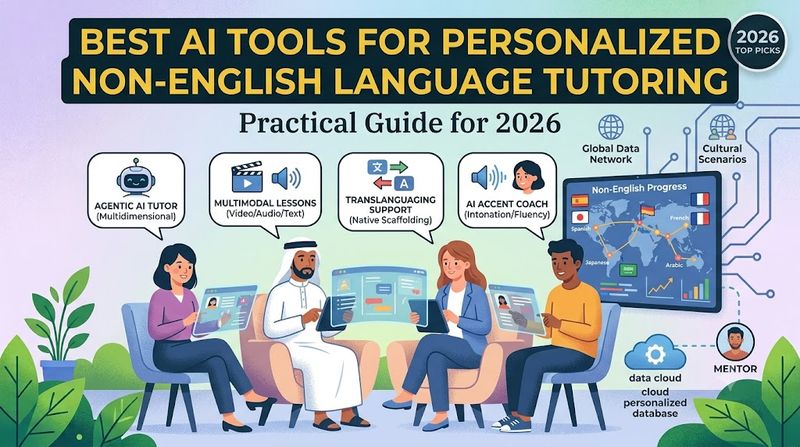
Language learning in 2026 has undergone a fundamental transformation. The era of one-size-fits-all vocabulary drills and rigid grammar exercises is giving way to something far more powerful: AI tutors that adapt to your level in real time, remember what you struggled with three conversations ago, and adjust their teaching style to match how you actually learn. For learners of non-English languages — whether you are studying Spanish for a career move, Japanese for cultural immersion, or an endangered indigenous language to preserve your heritage — this shift is nothing short of revolutionary.
What makes 2026 different is not just the existence of AI language tools, but the depth of their personalization. Modern AI tutors do not merely sort you into beginner, intermediate, or advanced buckets and run you through a pre-built lesson tree. They track the grammar patterns you keep missing, adjust difficulty mid-sentence during conversation practice, build review cards from sentences you actually spoke, and even pivot lesson topics based on your stated interests — whether that is preparing for a business trip to Lisbon, understanding anime without subtitles, or connecting with grandparents in their native tongue.
This guide cuts through the marketing noise to identify which AI tools actually deliver on personalization for non-English language learning, how they work under the hood, and how to choose the right one for your specific goals, budget, and target language.
1. Why Personalized AI Tutoring Matters in 2026
Traditional language learning has always suffered from a fundamental mismatch: every learner gets the same curriculum, delivered at the same pace, regardless of their native language, learning goals, or existing knowledge gaps. A Mandarin speaker learning Japanese faces entirely different challenges than a French speaker learning Japanese, yet most apps treat them identically. An engineer preparing for a technical conference in Berlin needs different vocabulary than a tourist planning a two-week vacation, yet they often share the same lesson path.
AI personalization solves this by treating you as an individual learner with a specific profile. The best AI tutors in 2026 adapt across multiple dimensions simultaneously:
Proficiency-Level Adaptation
AI tutors assess your level continuously, not just once during onboarding. Stumble on the subjunctive three times in a conversation, and the AI circles back two minutes later in a new context. Master a grammar point quickly, and the system accelerates past it rather than forcing you through redundant drills.
Interest-Driven Content
Mention that your sister is visiting Lisbon next weekend, and a truly personalized AI tutor pivots into restaurant phrases, transportation vocabulary, and cultural etiquette for Portugal. Mention that you need to present at a conference in Tokyo, and the AI shifts to formal business Japanese, presentation structures, and polite honorifics. This is not pre-scripted scenario selection — it is real-time topic adaptation based on conversational context.
Native Language-Aware Instruction
Personalized AI tutors understand your native language and anticipate the specific errors you are likely to make. A Spanish speaker learning Italian will struggle with false cognates differently than a German speaker learning Italian. The AI tracks these patterns and provides targeted explanations rather than generic grammar rules.
Learning Style Calibration
Some learners retain vocabulary best through visual association, others through audio repetition, and others through contextual storytelling. AI tutors analyze your performance across different input types and gradually weight the methods that work best for you, creating a genuinely individualized learning experience.
The result is a learning velocity that traditional methods simply cannot match. According to research from MIT Technology Review, modern AI language models have learned to read meaning, tone, and intention in learner speech, giving support that feels intuitive and personalized rather than mechanical and rule-based. This contextual understanding is what separates 2026's AI tutors from the chatbots of even two years ago.
2. How AI Personalization Actually Works
Understanding the technology behind AI language tutoring helps you evaluate which tools are genuinely adaptive and which are merely marketing themselves as such. The personalization stack in 2026 operates across four layers:
Layer 1: Conversational Memory and Context Retention
The most advanced AI tutors maintain memory across sessions. They remember that you struggled with the past subjunctive in last Tuesday's conversation, that you are planning a trip to Barcelona, and that you prefer learning through dialogue rather than flashcards. This memory enables continuity that mimics a human tutor who has worked with you for months. When you return for today's session, the AI does not start from zero — it builds on your established learning history.
Layer 2: Real-Time Speech Analysis and Adaptive Difficulty
Proprietary speech recognition models — not generic third-party APIs — power the best AI conversation tools. These models analyze not just whether you pronounced a word correctly, but your speaking rhythm, hesitation patterns, sentence complexity, and filler word usage. When the AI detects that you are struggling, it simplifies vocabulary and slows its speech rate mid-conversation. When you are flowing smoothly, it introduces more complex structures and faster speech to push your edge.
Layer 3: Spaced Repetition with Personalized Content
Traditional spaced repetition systems show you the same flashcards on a fixed schedule. AI-enhanced systems generate review content from sentences you actually spoke during practice, not from a pre-built deck. If you misused the conditional tense in a conversation about travel plans, your next review card will feature that exact grammatical structure in a new travel context. This contextual reinforcement is significantly more effective than isolated vocabulary drills.
Layer 4: Multimodal Learning Integration
The most sophisticated platforms integrate text, audio, video, and even augmented reality. Native speaker video clips provide authentic pronunciation and cultural context. AI-generated stories incorporate your personal interests and previously learned vocabulary. Some platforms allow you to upload photos, PDFs, or voice notes for the AI to analyze and incorporate into lessons. This multimodal approach accommodates different learning preferences while reinforcing the same content through multiple channels.
3. Top AI Tools for Personalized Non-English Language Tutoring
After evaluating platforms on depth of personalization, conversation quality, language coverage, and practical value, these are the standout AI tutoring tools for non-English language learning in 2026.
ISSEN — Best Overall for Deep Personalization
ISSEN is an AI voice tutor built for real-time conversation across 60+ languages. What distinguishes it is conversation-level personalization: the tutor drives sessions like a human teacher would, picks topics from your stated interests, and shifts difficulty mid-sentence based on your performance. It remembers your goals and previous sessions, creating continuity that most competitors lack.
Key features: Real-time voice conversations in 60+ languages with memory across sessions; accent options including American, British, Australian, Argentinian, Mexican, and Spain Spanish; dedicated Shadowing mode for pronunciation training; in-context flashcards with spaced repetition pulled from sentences you actually used; background mode for hands-free practice on walks and commutes; iOS, Android, and web with instant sync.
Best for: Learners who want a tutor that adapts to their interests and remembers their history across sessions, especially those studying multiple languages simultaneously.
Pricing: $20-29 per month.
Speak — Best for Structured Speaking Practice
Speak uses proprietary speech AI to deliver unlimited conversation practice with an adaptive AI tutor that adjusts in real time to your level and mistakes. Unlike gamified apps that focus on translation drills, Speak prioritizes actual speaking — the skill most learners struggle with — and offers personalized feedback on pronunciation, grammar, and fluency across 17+ languages.
Key features: Proprietary speech AI for natural, real-time conversation; adaptive difficulty that adjusts to your level mid-conversation without manual settings; structured curriculum paths alongside freeform practice; fast AI response during speaking exercises with minimal processing lag; clean, low-friction mobile interface.
Best for: Beginners who want structured lessons plus built-in speaking practice without designing their own study path. Particularly strong for English, Spanish, Korean, Japanese, and French.
Pricing: Free trial, then from $13.99 per month.
Langua — Best for Open-Ended AI Conversation
Langua focuses on speaking and listening through AI-simulated dialogues. Its Call Mode lets you have hands-free voice conversations with voices cloned from real native speakers, making them sound more human than typical text-to-speech. The Communicate With AI tool lets you chat by typing or recording your voice, with the AI playing back replies, showing text on screen, and allowing you to slow down or translate as needed.
Key features: Hands-free Call Mode with cloned native speaker voices; structured A1 to A2 courses for beginners plus open AI practice for intermediate and advanced learners; in-app resources including YouTube videos and podcasts; role-play scenarios for real-life situations; male and female voice options for the chatbot.
Best for: Learners who want flexible, open-ended conversation practice and are comfortable with a less polished interface in exchange for functional depth. Supports 20+ languages.
Pricing: Limited free tier; Standard $19.99/month or Unlimited $29.99/month, with cheaper annual rates.
ELSA Speak — Best for Pronunciation Accuracy
ELSA Speak is the standout choice when pronunciation accuracy is your primary goal. Its AI provides granular, phoneme-level feedback on every utterance — showing you exactly which sounds you are mispronouncing and how to correct them. The accent reduction features are particularly strong, using speech analysis trained on thousands of non-native speakers.
Key features: Phoneme-level pronunciation feedback unmatched by competitors; AI accent coaching trained on thousands of non-native speaker patterns; detailed scoring across multiple pronunciation dimensions; free tier with meaningful functionality.
Best for: Learners who need to refine their accent for professional contexts, acting, or integration into a native-speaking community. Scope is narrower than full-curriculum apps but unmatched within its niche.
Pricing: Free tier available; paid plans from $11.99 per month.
TalkPal — Best Budget Option for Broad Language Coverage
TalkPal offers AI conversation practice across 57+ languages at a budget price point, making it the most accessible option for learners studying less common languages that other apps ignore entirely. While the AI voice quality is less natural than Speak or Langua, and the free tier limits you to roughly 10 messages per day, the breadth of language coverage is unmatched at this price point.
Key features: 57+ languages including many less commonly taught options; flexible AI conversation practice; budget-friendly pricing; role-play scenarios available.
Best for: Budget-conscious learners who want flexible AI conversation practice across a wide range of languages without committing to a premium subscription.
Pricing: Free tier with daily limits; affordable premium subscription.
Praktika — Best for Visual Learners
Praktika builds AI avatar tutors with animated faces across English, Spanish, Japanese, Korean, French, Portuguese, Italian, and German. The multimodal lessons allow you to upload photos, PDFs, and voice notes for the AI to incorporate into your learning. The visual presence of an avatar can make practice feel more engaging for learners who find text-only or voice-only interfaces impersonal.
Key features: Animated avatars with American, British, and Latin American accents; multimodal lesson inputs (photos, PDFs, voice notes); adaptive practice across speaking, listening, and vocabulary; multiple accent options per language.
Best for: Visual learners who want a face on the other side of the screen and a low-cost entry into AI conversation practice. Note that on the free tier, the AI can occasionally mix up languages and accents.
Pricing: Around $8 per month.
Duolingo Max — Best for Gamified Daily Habit
Duolingo remains the world's most-downloaded language learning app, and its Max tier adds GPT-4-powered features to the familiar gamified framework. Explain My Answer breaks down why your response was right or wrong in plain language, while Roleplay puts you in open-ended AI conversations tied to real-world scenarios. The adaptive path powered by Birdbrain reads your performance and tunes lesson difficulty.
Key features: 40+ languages including Navajo, Hawaiian, and High Valyrian; best-in-class streak and habit mechanics; Explain My Answer and Roleplay for substantive AI interaction; adaptive lesson paths; free tier with comprehensive lesson trees.
Best for: Beginners who need motivational scaffolding to establish a daily learning habit. Works best as a vocabulary and grammar supplement paired with a conversation-focused app for speaking development.
Pricing: Free; Super Duolingo $13.99/month or $95.99/year; Duolingo Max around $29.99/month or $167.99/year.
4. Best Tools for Less Commonly Taught Languages
Learners of languages outside the Spanish-French-German-Japanese core face a frustrating reality: most AI tools simply do not support them. If you are learning Tagalog, Thai, Romanian, Finnish, Yoruba, Mongolian, or any of hundreds of other languages, your options narrow significantly. Here is how to find AI support for less common languages:
TalkPal: 57+ Languages Including Many Less Common Options
TalkPal's broad language coverage includes options that major platforms ignore. While the conversation quality may not match Speak or Langua, it is often the only AI conversation option available for languages like Bulgarian, Croatian, Latvian, or Lithuanian.
Duolingo: Surprising Breadth with AI Features
Duolingo supports over 40 languages, including several less commonly taught options like Navajo, Hawaiian, and Welsh. While the AI-powered Explain My Answer and Roleplay features are not available for all languages, the core adaptive path and spaced repetition system work across the full catalog. For languages with smaller speaker bases, Duolingo is often the most technologically advanced option available.
Pimsleur: 51 Languages with Audio-First Method
Pimsleur covers 51 languages including Chinese, Italian, Russian, Vietnamese, Tagalog, German, Romanian, Finnish, and more. The audio-first graduated interval method is particularly effective for languages with unfamiliar phonetic systems, as it trains your ear before your eye. The AI-enhanced review sessions adapt to your weakest areas, making this a strong option for auditory learners of less common languages.
Memrise: 20+ Languages with Native Speaker Video
Memrise includes less common options like Mongolian and Yoruba alongside major languages. Its signature feature — video clips of native speakers using words and phrases in real-world contexts — is especially valuable for languages where authentic media is hard to find. The AI-powered spaced repetition system is well-tuned for long-term vocabulary retention.
Custom AI Solutions for Truly Rare Languages
For languages with very few speakers or minimal digital resources, custom AI solutions are emerging. Researchers and community organizations are fine-tuning large language models on limited corpora of text, audio, and cultural materials to create tutoring systems for indigenous and endangered languages. These projects are typically community-led rather than commercial, but they represent the frontier of AI language support.
5. AI and Endangered Language Preservation
Perhaps the most profound application of AI language tutoring in 2026 extends beyond individual learners to entire communities. Linguists estimate that one language disappears every two weeks, and by 2100, more than half of the approximately 7,000 languages spoken today may be gone. When a language dies, what disappears is not only vocabulary — entire systems of ecological knowledge, oral law, medicinal practice, and collective memory are lost.
How Generative AI Is Helping Preserve Endangered Languages
Multimodal AI models can now generate natural-sounding speech in languages with fewer than 500 speakers, learning from just a few hours of recorded speech to produce new sentences, stories, and conversations that native speakers find authentic. The Maori Language Commission in New Zealand has deployed generative voice models that allow students to practice conversational skills with AI tutors that adapt to their proficiency level.
Google Woolaroo: Visual Language Learning
Google's Woolaroo is a mobile application that lets users point their phone camera at an object and hear its name spoken in an endangered language. It supports more than 30 languages, including Ainu from Japan, Yiddish, and several indigenous languages of the Americas. Native speakers provide pronunciation and vocabulary, and the app connects visual identification with spoken language in real time. In Louisiana, Creole speakers use the app to teach children everyday words that are no longer in common use, integrating language learning into daily routines rather than confining it to classrooms.
Community-Led AI Initiatives
The most effective AI preservation systems combine large language models with retrieval-augmented generation that pulls from verified cultural archives, elder recordings, and anthropological records. This approach reduces cultural hallucination while maintaining linguistic creativity. The Hawaiian language revitalization program reported a 340% increase in new fluent speakers under 18 after deploying generative AI tutoring applications that create personalized stories incorporating family names and local geography. In Australia, the Warlpiri community used generative AI to create an ever-expanding library of children's books in their language, featuring traditional Dreamtime stories reimagined for contemporary contexts.
Ethical Considerations
Using AI for language preservation raises important questions about authenticity, community consent, and cultural ownership. Leading projects in 2026 ensure indigenous communities maintain control over training data and model outputs. Successful initiatives follow strict governance frameworks that prioritize community leadership over technological solutionism. Technology alone cannot save languages — it works best as one component in broader community-led revitalization efforts that include immersion programs, policy changes, and increased visibility.
6. AI Tools for Speaking and Pronunciation
Speaking is the skill most language learners struggle with, and it is where AI has made the most dramatic advances. The gap between understanding a language and being able to speak it confidently is where traditional self-study methods consistently fail. Here is how AI is closing that gap:
Real-Time Conversation Simulation
AI tutors like Speak, Langua, and ISSEN engage in back-and-forth dialogue that adapts to your level. Unlike scripted role-play, these conversations are genuinely open-ended. You can go off-topic, ask questions, express confusion, and the AI responds naturally. This low-pressure environment removes the social anxiety that prevents many learners from speaking with native speakers.
Phoneme-Level Pronunciation Feedback
ELSA Speak provides the most granular pronunciation feedback available, analyzing your speech at the phoneme level to identify exactly which sounds you are mispronouncing. It shows you tongue placement diagrams, plays correct pronunciations, and tracks your improvement over time. For learners preparing for professional contexts where accent clarity matters, this level of precision is invaluable.
Shadowing and Repetition Training
ISSEN's dedicated Shadowing mode and Pimsleur's graduated interval recall method both train speaking through repetition and mimicry. You hear a native phrase, repeat it immediately, and receive feedback on your accuracy. Over time, this builds muscle memory for correct pronunciation and sentence rhythm. The AI adjusts the difficulty and speed of phrases based on your performance.
Hands-Free Audio Practice
For commuters, walkers, and anyone who studies away from a screen, hands-free audio practice is essential. Pimsleur's audio-first method, Langua's Call Mode, and ISSEN's background mode all allow you to practice speaking and listening while doing other activities. This transforms dead time — commutes, exercise, household chores — into productive language practice.
7. Grammar, Vocabulary, and Contextual Learning
While speaking practice gets the headlines, AI is equally transformative for the foundational skills of grammar and vocabulary acquisition. The key shift is from abstract rule memorization to contextual, just-in-time learning.
Contextual Grammar Explanation
Instead of presenting grammar rules in isolation, AI tutors explain mistakes in the context of the conversation you are having. When you misuse the subjunctive in a discussion about future plans, the AI explains why your choice was incorrect, shows the correct form, and immediately gives you another opportunity to use it correctly in a similar context. This just-in-time feedback is significantly more effective than studying grammar chapters out of sequence.
Duolingo's Explain My Answer
Duolingo Max's Explain My Answer feature, made free for all users in January 2026, uses GPT-4 to break down why your response was right or wrong in plain language. Unlike static explanations, it can answer follow-up questions and adapt its explanation to your specific misconception. This transforms error correction from a simple "wrong answer" notification into a genuine teaching moment.
Vocabulary Through Stories, Not Lists
AI-generated stories incorporate your personal interests, previously learned vocabulary, and current learning objectives. Instead of memorizing "apple, banana, orange" from a list, you learn fruit vocabulary within a story about shopping at a market in Barcelona — complete with cultural context, realistic dialogue, and grammar structures you have recently studied. This contextual embedding dramatically improves retention.
Spaced Repetition from Real Usage
The most effective AI systems do not use pre-built flashcard decks. They generate review content from sentences you actually spoke or wrote during practice. If you struggled with the conditional tense in a conversation about travel, your review card will feature that exact structure in a new travel context. This personalized spaced repetition is more effective than generic decks because the content is already meaningful to you.
8. Step-by-Step Guide to Choosing Your AI Tutor
With dozens of options available, selecting the right AI language tutor requires matching the tool to your specific situation. Follow this decision framework:
Step 1: Define Your Primary Goal
Be specific. "Learn Spanish" is too vague. "Hold a 10-minute conversation with my partner's family in Mexico City" or "Negotiate a contract in German" or "Understand anime without subtitles" are concrete objectives that dictate which tool features matter most. Your goal determines whether you need conversation-first, pronunciation-focused, grammar-heavy, or vocabulary-intensive support.
Step 2: Identify Your Target Language
Check which platforms support your target language with full AI features. Major languages (Spanish, French, German, Japanese, Korean, Italian, Portuguese) are well-covered. Less common languages require checking TalkPal, Pimsleur, Duolingo, or Memrise for coverage. Endangered or indigenous languages may require community-led AI projects rather than commercial apps.
Step 3: Assess Your Learning Style
Are you motivated by gamification and streaks? Duolingo Max. Do you need structured lessons with clear progress markers? Speak or Babbel. Do you prefer open-ended conversation without rigid curriculum? Langua or ISSEN. Are you an auditory learner who studies during commutes? Pimsleur or ISSEN's background mode. Do you need visual engagement? Praktika's avatars or Memrise's native speaker videos.
Step 4: Evaluate Personalization Depth
Most apps personalize once during onboarding and call it done. True personalization happens mid-conversation and across sessions. Ask: Does the tutor remember my previous sessions? Does it adapt topics based on my interests? Does it adjust difficulty in real time? Does it generate review content from my actual mistakes? ISSEN and Speak lead here; Duolingo and Memrise lag.
Step 5: Test Before Committing
Use free trials and freemium tiers to test 2-3 platforms simultaneously. Spend at least three sessions with each before deciding. Pay attention to: whether the AI feels natural or robotic; whether feedback is specific or generic; whether the interface encourages or frustrates you; and whether you actually look forward to using it. The best tool is the one you will actually use consistently.
Step 6: Plan Your Tool Stack
Most serious learners benefit from combining two tools: one for structured learning and vocabulary (Duolingo, Babbel, or Memrise) and one for conversation practice (Speak, Langua, or ISSEN). This dual approach covers both the foundational knowledge and the active skill that foundation supports.
9. Building a Multi-Tool Learning Stack
No single AI tool does everything perfectly. The most effective language learners in 2026 build a personalized stack of complementary tools, each addressing a different learning need. Here are proven combinations:
The Conversation-First Stack
Primary: Speak or ISSEN for daily conversation practice
Secondary: Duolingo for vocabulary building and grammar fundamentals
Supplement: ELSA Speak for pronunciation refinement
Best for: Learners who need to speak confidently in professional or social contexts within 6-12 months.
The Budget-Conscious Stack
Primary: Duolingo (free tier) for daily habit and vocabulary
Secondary: TalkPal (free tier) for conversation practice
Supplement: YouTube native speaker content for listening exposure
Best for: Learners with limited budget who are self-motivated and can tolerate ads and daily usage limits.
The Multi-Language Stack
Primary: ISSEN for conversation practice across multiple languages
Secondary: Duolingo for vocabulary in each target language
Supplement: Pimsleur for audio-only practice during commutes
Best for: Polyglots or learners studying multiple languages simultaneously who need a single conversation platform that handles language switching.
The Pronunciation-Perfection Stack
Primary: ELSA Speak for phoneme-level pronunciation training
Secondary: Speak or Langua for conversation practice applying corrected pronunciation
Supplement: Memrise for native speaker video exposure
Best for: Actors, singers, professionals in client-facing roles, or anyone who needs near-native accent clarity.
The Heritage Language Stack
Primary: Community-led AI tools or Woolaroo for endangered/indigenous languages
Secondary: TalkPal or Duolingo if the language is supported
Supplement: Family member recordings and cultural materials
Best for: Learners reconnecting with heritage languages where commercial tools may not exist.
10. Costs, Pricing, and Free Options
AI language tutoring in 2026 spans from completely free to premium subscriptions. Understanding the trade-offs helps you allocate your budget effectively.
| Tool | Free Tier | Premium Cost | Best Value Proposition |
|---|---|---|---|
| Duolingo | Full core course with ads | Super $13.99/mo; Max ~$29.99/mo | Best free option for building daily habits across 40+ languages |
| TalkPal | ~10 messages/day | Affordable premium (varies by plan) | Broadest language coverage at budget price |
| ELSA Speak | Meaningful functionality | From $11.99/mo | Unmatched phoneme-level pronunciation feedback |
| Speak | Free trial + capped daily conversations | From $13.99/mo | Best structured speaking practice with proprietary speech AI |
| Langua | Limited daily usage | Standard $19.99/mo; Unlimited $29.99/mo | Most natural open-ended AI conversation with cloned voices |
| ISSEN | Free trial | $20-29/mo | Deepest personalization with memory across 60+ languages |
| Praktika | Limited | ~$8/mo | Cheapest entry to AI avatar tutoring with multimodal inputs |
| Pimsleur | Free lesson + 7-day trial | Premium $19.95/mo; All Access $20.95/mo | Best audio-only method for 51 languages |
| Memrise | Starter units | From $8.49/mo | Native speaker video clips for authentic context |
| Babbel | First lesson of each course | From $7.99/mo | Strongest grammar structure and real-world dialogue focus |
Maximizing Value
For most learners, the optimal budget allocation is: one free or low-cost tool for structured vocabulary and grammar (Duolingo free tier or Babbel at $7.99/month) plus one conversation-focused tool (Speak, Langua, or ISSEN at $14-29/month). This combination typically costs $15-35 monthly and covers both foundational knowledge and active speaking skills.
Many platforms offer significant discounts for annual subscriptions — often 30-50% cheaper than monthly billing. If you are committed to a 6+ month learning journey, annual plans are usually the better value. Most also offer 7-day to 30-day money-back guarantees, reducing the risk of committing to a full year.
11. Common Mistakes to Avoid
Mistake 1: Relying on a Single Tool
Every AI language tool has strengths and weaknesses. Duolingo builds habits but does not build speaking fluency. ELSA perfects pronunciation but does not teach conversation. Speak enables conversation but covers only six languages. The most successful learners combine complementary tools rather than expecting one app to deliver everything.
Mistake 2: Confusing Gamification with Progress
Duolingo's streaks, XP points, and leaderboards are genuinely effective at building daily habits. But they can create a false sense of progress. You may maintain a 100-day streak while still freezing in real conversations. Use gamification as a motivational tool, not a progress metric. Test your actual speaking ability regularly with a human or AI conversation partner.
Mistake 3: Ignoring Pronunciation Early
Many learners delay pronunciation work until they are "conversational," cementing bad habits that become nearly impossible to unlearn. Start pronunciation training in your first month, even if it feels premature. ELSA Speak or ISSEN's Shadowing mode can prevent fossilized errors that plague advanced learners.
Mistake 4: Studying Without Speaking
Reading, listening, and vocabulary drills are comfortable. Speaking is uncomfortable. Many learners spend months building passive knowledge without ever activating it. The result is the familiar "I understand everything but cannot say anything" plateau. Force yourself to speak from week one, even if it is just repeating phrases to an AI tutor.
Mistake 5: Chasing Perfection Before Progress
Language learning is inherently messy. You will make mistakes, sound foolish, and misunderstand constantly in the early months. AI tutors are patient and non-judgmental — use that safety to push through the awkward phase. Waiting until you "know enough" to start speaking is a trap that prevents progress.
Mistake 6: Not Adapting Your Stack Over Time
Your needs change as you advance. A beginner benefits from Duolingo's structure and gamification. An intermediate learner needs open conversation with Langua or ISSEN. An advanced learner may need specialized vocabulary for their profession and nuanced cultural context. Reassess your tool stack every three months and adjust as your level evolves.
12. Future Trends: Where AI Language Tutoring Is Heading
Emotion-Aware Conversation Systems
Next-generation AI tutors will recognize frustration, confusion, boredom, and excitement in your speech patterns and facial expressions. When you are struggling, the AI will simplify and encourage. When you are engaged, it will challenge you more aggressively. This emotional calibration will make AI tutoring feel even more human.
Real-Time Translation and Conversation Support
By 2030, experts predict AI will enable real-time translation and conversation tools that support endangered languages as fluidly as major world languages. This could dramatically change language attitudes and increase the prestige associated with speaking indigenous tongues. For learners, it means the ability to practice with native speakers across any language barrier.
Story Worlds Tailored to Your Interests
AI will generate entire immersive story worlds — complete with characters, plotlines, and cultural settings — built around your specific interests and learning objectives. A learner interested in cooking might navigate a virtual Italian market, negotiating with vendors and learning food vocabulary in context. A business learner might participate in a simulated Japanese boardroom meeting. These immersive environments will make language practice feel like entertainment rather than study.
Predictive Learning Plateau Detection
AI systems will analyze your learning trajectory to predict when you are approaching a plateau — the frustrating period where progress seems to stall. Before you hit the wall, the AI will adjust methodology, introduce new content types, or increase challenge to push you through. This proactive intervention will reduce the dropout rate that plagues language learners at intermediate levels.
Integration with Professional and Academic Contexts
AI tutors will increasingly simulate work-specific scenarios in real time — job interviews, client presentations, academic conferences, medical consultations. Rather than generic "ordering at a restaurant" roleplay, you will practice the exact conversations your career requires, with vocabulary and formality calibrated to your industry and target culture.
13. Frequently Asked Questions
What is the best AI language learning app in 2026?
It depends on your goal. For real conversation practice and deep personalization, ISSEN or Speak are the strongest choices. For gamified daily habit building, Duolingo Max. For pronunciation accuracy, ELSA Speak. For budget-conscious learners of less common languages, TalkPal. Most serious learners combine two tools: one for vocabulary and grammar, one for speaking practice.
Can AI tutors really replace human language teachers?
AI tutors excel at providing unlimited conversation practice, patient error correction, and personalized pacing at a fraction of the cost of human tutors. However, they cannot fully replace human teachers for cultural nuance, complex grammar explanation, and the motivational accountability of a scheduled human relationship. The most effective approach combines AI practice for daily reps with periodic human tutoring for advanced feedback and cultural immersion.
Do AI language tutors work for less commonly taught languages?
Yes, but options are more limited. TalkPal covers 57+ languages including many less common options. Pimsleur supports 51 languages. Duolingo offers 40+ including some less common choices like Navajo and Hawaiian. For truly rare or endangered languages, you may need to explore community-led AI projects or tools like Google Woolaroo rather than commercial apps.
How much do AI language tutoring tools cost?
Most quality AI language tools range from free (Duolingo's core course, TalkPal's limited free tier) to $30 per month for premium features. A typical learner invests $15-35 monthly for a combination of one free/low-cost structured app and one premium conversation tool. Annual subscriptions typically offer 30-50% savings over monthly billing.
Can I learn multiple languages simultaneously with AI tutors?
Yes. ISSEN supports 60+ languages with full conversation features in each, allowing you to switch between German practice in the morning and Spanish at night. Duolingo also supports multiple language profiles. However, learning multiple languages simultaneously requires more time and can slow progress in each. Most experts recommend reaching at least a solid intermediate level in one language before adding a second.
Is the free version of Duolingo enough?
Duolingo's free tier is genuinely useful for building vocabulary, establishing a daily habit, and learning basic grammar across 40+ languages. However, it is not sufficient for developing speaking fluency or advanced comprehension. The ads and heart/life system can interrupt momentum. For serious learners, Duolingo works best as a supplement to a conversation-focused tool rather than a standalone solution.
How do I know if an AI tutor is actually personalized or just marketing?
True personalization shows up in three ways: the tutor remembers details from previous sessions (not just your level from onboarding); it adjusts difficulty or topics in real time during conversation based on your performance; and it generates review content from your actual mistakes rather than using a fixed curriculum. If the app feels the same on day 30 as it did on day 1, it is not truly personalized.
Can AI help preserve endangered or indigenous languages?
Yes. Generative AI is already being used to create tutoring applications, synthetic speech models, and educational materials for endangered languages. The Hawaiian language revitalization program saw a 340% increase in young fluent speakers after deploying AI tutoring. However, successful preservation requires community leadership and control over data and outputs — technology alone cannot save a language without community engagement.
How long does it take to see results with AI language tutoring?
With consistent daily practice (20-30 minutes), most learners notice measurable improvement in vocabulary and basic comprehension within 4-6 weeks. Speaking confidence typically develops over 3-6 months. The key is consistency — AI tutors are available 24/7, but they cannot practice for you. Learners who maintain daily engagement progress significantly faster than those who study in sporadic bursts.
What about privacy when using AI language tutors?
Most reputable platforms encrypt voice data and do not share it with third parties. However, some apps use human reviewers to improve AI models or may retain conversation data for training purposes. Check the privacy policy before using any platform, especially if you discuss sensitive personal information during practice sessions. Look for platforms with explicit no-human-review policies and clear data deletion rights.
14. Conclusion: Your Personalized Path to Fluency
The AI language tutoring landscape in 2026 offers something genuinely new: the ability to learn a language in a way that adapts to you, rather than forcing you to adapt to a rigid curriculum. Whether you are a beginner building your first vocabulary, an intermediate learner breaking through the speaking plateau, or a heritage speaker reconnecting with an endangered language, there is an AI tool that can meet you where you are and guide you forward.
The key is not finding the "best" app in absolute terms, but finding the best combination of tools for your specific goals, learning style, target language, and budget. Start with one conversation-focused tool and one structured learning tool. Use them consistently for 30 days. Evaluate whether you are actually speaking more confidently, understanding more naturally, and looking forward to your practice sessions. Adjust your stack as you advance.
AI cannot replace the human joy of connecting with another person in their native language. But it can remove the barriers — cost, access, embarrassment, scheduling — that prevent most people from ever reaching that point. The technology is ready. The only question is whether you will start today.
Related Tags

About the Author
Freya O'Neill
freya-o-neill is a technology journalist specializing in artificial intelligence, software innovation, cybersecurity, and emerging digital trends. She enjoys explaining complex technologies in clear, accessible language for both professionals and everyday readers.
Enjoyed this article?
Check out more content on our blog or follow us on social media.
Browse more articles