Automating Bookkeeping with AI Agents for Small Retail Businesses in 2026

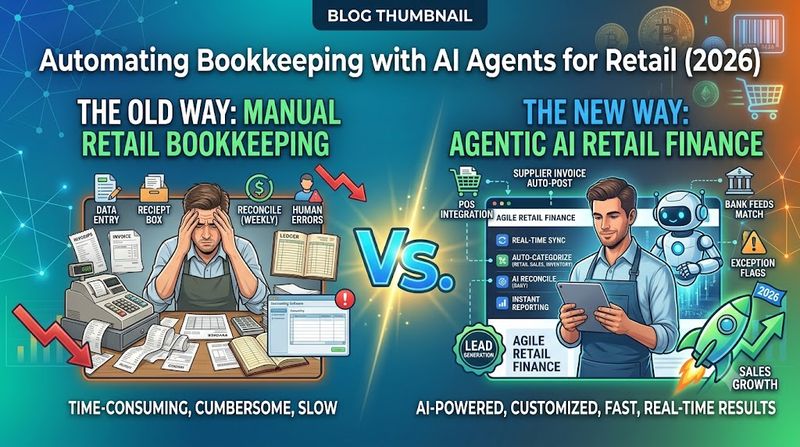
Running a small retail business means juggling inventory, customer service, marketing, and endless paperwork. Bookkeeping often falls to the bottom of the list — or gets outsourced at a high cost. In 2026, AI agents are changing the game by automating repetitive financial tasks, reducing errors, and giving store owners real-time insights.
This guide explores how AI-powered bookkeeping works for small retail businesses, the best tools available, real results versus traditional methods, and how to get started safely.
Why Small Retail Businesses Struggle with Bookkeeping
Retail owners face unique challenges:
- High volume of daily transactions (POS sales, online orders, returns)
- Inventory tracking across multiple channels
- Seasonal cash flow fluctuations
- Sales tax compliance across locations
- Reconciling payments from multiple processors (Square, Stripe, Shopify, cash)
Manual bookkeeping eats hours every week and increases the risk of costly mistakes or missed tax deductions.
What Are AI Bookkeeping Agents?
AI bookkeeping agents are intelligent automation tools that connect to your bank accounts, POS systems, e-commerce platforms, and accounting software. They can:
- Automatically categorize transactions
- Reconcile accounts daily
- Generate financial reports and forecasts
- Flag anomalies or potential fraud
- Prepare tax-ready documents
- Handle invoice processing and expense tracking
Advanced agents use natural language processing so you can ask questions like “What were my clothing sales last month?” or “Show me unpaid supplier invoices.”
Key Benefits for Small Retail in 2026
Time Savings
Many retailers report cutting bookkeeping time by 70-90%. What once took 10-15 hours per month can now be reduced to quick reviews.
Improved Accuracy
AI reduces human error in categorization and reconciliation. Machine learning models trained on retail data get smarter over time.
Better Cash Flow Visibility
Real-time dashboards show profit margins by product category, slow-moving inventory, and upcoming expenses.
Cost Reduction
Many small businesses save thousands annually by minimizing accountant fees for routine tasks.
Compliance & Tax Readiness
Automatic sales tax tracking, expense categorization for deductions, and audit-ready records.
Best AI Bookkeeping Tools for Retail Businesses in 2026
1. QuickBooks AI Features + Integrations
Enhanced AI categorization, receipt scanning, and predictive cash flow. Excellent Shopify and Square integrations.
2. Xero with AI Assistants
Strong for multi-channel retail with inventory accounting and bank reconciliation automation.
3. FreshBooks AI
User-friendly for smaller stores with automated invoicing and expense tracking.
4. Specialized AI Agents (e.g., Bookkeeper.com, Vic.ai, or custom GPT-powered agents)
Autonomous agents that work across platforms and can be queried conversationally.
5. Bench + AI or Pilot
Hybrid human + AI bookkeeping services tailored for small businesses.
AI Agents vs. Traditional Bookkeeping
| Aspect | Manual / Traditional | AI Agents |
|---|---|---|
| Time Required | High (weekly hours) | Minimal (review only) |
| Error Rate | Higher | Significantly lower |
| Cost | Accountant fees + owner time | Subscription + reduced fees |
| Insights | Delayed monthly reports | Real-time dashboards & forecasts |
| Scalability | Poor | Excellent |
Real Results: Case Studies from Small Retailers
A boutique owner in Portland reduced monthly bookkeeping from 12 hours to under 2 hours while catching $3,200 in missed deductions. An independent hardware store automated inventory cost tracking and improved gross margin visibility by 18%.
Businesses using AI agents consistently report faster month-end close and fewer surprises during tax season.
How to Implement AI Bookkeeping Safely
- Assess your current systems (POS, e-commerce, bank feeds)
- Choose tools with strong security and retail-specific integrations
- Start with automation of high-volume tasks (transaction categorization)
- Maintain human oversight for approvals and complex decisions
- Work with a CPA familiar with AI tools for year-end review
- Regularly review and train the AI with your business rules
Potential Challenges & Solutions
Data Privacy: Use platforms with bank-level encryption and SOC 2 compliance.
Learning Curve: Most modern tools have excellent onboarding and support.
Integration Issues: Prioritize tools with native connectors to your existing stack.
Over-reliance: Always keep a human in the loop for final financial decisions.
The Future of Retail Finance in 2026 and Beyond
AI agents are evolving from simple automation to predictive business advisors. Soon, they will forecast seasonal inventory needs, suggest pricing adjustments, and even prepare loan applications based on your financial health.
For small retail businesses, adopting AI bookkeeping is no longer a luxury — it’s becoming essential for staying competitive and profitable.
Getting Started Today
Begin by connecting your bank and primary sales channels to a tool like QuickBooks or Xero. Enable AI categorization features and spend one afternoon reviewing initial results. Within weeks, you’ll reclaim valuable time and gain clearer visibility into your store’s financial health.
Have questions about implementing AI for your specific retail setup? Share your biggest bookkeeping pain point in the comments below.
Related Tags

About the Author
Freya O'Neill
freya-o-neill is a technology journalist specializing in artificial intelligence, software innovation, cybersecurity, and emerging digital trends. She enjoys explaining complex technologies in clear, accessible language for both professionals and everyday readers.
Enjoyed this article?
Check out more content on our blog or follow us on social media.
Browse more articles