AGI Timeline Debate 2025: Expert Predictions – Are We 2 Years or 20 Years Away?

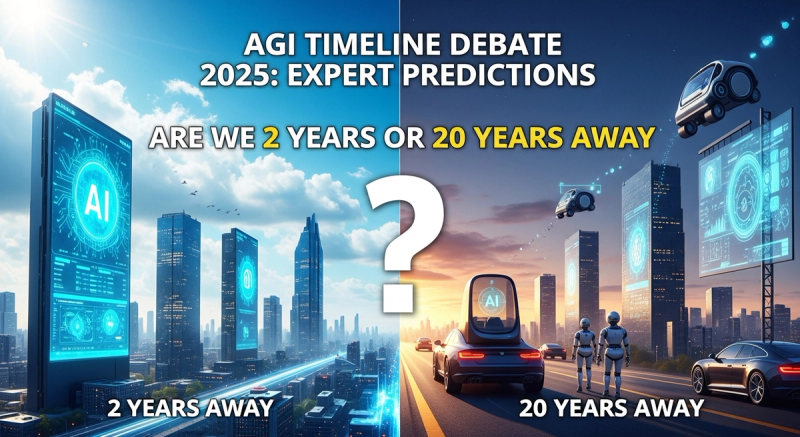
The race toward Artificial General Intelligence (AGI) has intensified by December 2025, with frontier models shattering benchmarks and prediction markets reflecting wild swings—from 35% odds for 2025 announcements in January to just 2% now. As labs like Anthropic forecast AGI by early 2027 and forecasters push medians to 2033, the divide between optimists eyeing 2 years and skeptics holding at 20+ persists. This isn't mere speculation; it shapes investments, policies, and preparations for transformative impacts. We unpack the latest arguments, evidence from recent surveys and CEO statements, and implications for our future.
The Optimists' Case: AGI by 2027
Proponents, led by AI CEOs, cite explosive scaling and emergent capabilities in models like Gemini 3 and Grok 4. Anthropic's Dario Amodei predicts AGI by early 2027, calling it a "country of geniuses in a datacenter." Elon Musk eyes 2026 at latest, while OpenAI's Sam Altman hints at superintelligence in "a few thousand days" (~2033, but accelerating). They emphasize:
- Exponential Scaling: Capabilities double yearly, per METR's task completion charts projecting human-level by 2028.
- Emergent Abilities: o3 and Claude 4.5 show reasoning, coding, and intent prediction rivaling humans.
- Hardware Acceleration: NVIDIA's Rubin chips and Groq's efficiency slash training times, compressing cycles.
Optimists, including François Chollet (~5 years), argue neuro-symbolic hybrids and multimodal advances bridge gaps, with Polymarket's early 2025 hype underscoring momentum. For them, AGI is imminent—before 2030, per AI 2027 report.
The Pessimists' Perspective: A 20-Year Horizon
Skeptics like Gary Marcus and Emily Bender decry brittleness in out-of-distribution tasks and unsolved safety. Recent Winter AI Safety Index critiques labs for catastrophe plan gaps, while energy demands for exascale training rival global output. They highlight:
- Common Sense Reasoning: AIs falter on causality and physics without explicit data, per ARC-AGI's 45% ceiling.
- Energy Requirements: Scaling to AGI could consume planetary resources, per IBM's neuromorphic warnings.
- Safety Challenges: Alignment lags capabilities, risking misalignment as superintelligence looms.
Pessimists invoke AI winters, noting Metaculus' 2033 median and surveys' 50% by 2059. Yann LeCun (~10 years) tempers hype, insisting paradigm shifts beyond transformers are needed.
Middle Ground: The 5-10 Year Compromise
Pragmatists converge on 2030s. 80,000 Hours' forecasters give 25% by 2027, 50% by 2031; Samotsvety ~28% by 2030. Meta's division eyes domain-specific AGI by 2028, full by 2035-2040. This balances progress with hurdles:
- Incremental Breakthroughs: Precursors like autonomous researchers by 2028, per AIMultiple's August report.
- Global Collaboration Needs: Frontier Model Forum standards essential for safe scaling.
- Regulatory Wildcards: EU AI Act's GPAI rules and U.S. NIST frameworks could calibrate pace.
Key Variables Shaping the Timeline
Factors tilting the scales include:
- Scientific Breakthroughs: Neuromorphic chips or quantum hybrids could halve estimates, per DeepMind's roadmap.
- Funding Ecosystems: U.S. National AI Initiative and private surges fuel velocity.
- Ethical Guardrails: Safety Consortium red-teaming builds trust but may delay releases.
- Geopolitical Tensions: U.S.-China rivalry prioritizes speed, per LessWrong analyses.
What AGI Arrival Might Mean
Timeline regardless, AGI heralds upheaval:
- Economic Transformation: Intellectual automation reshapes jobs, per AI 2027's 2030 forecasts.
- Scientific Revolution: Solves grand challenges like fusion, accelerating via embodied AI.
- Existential Questions: Redefines purpose; Nick Bostrom warns of risks, Ray Kurzweil of utopia.
With p(doom) debates raging, preparation via literacy and governance is key.
Conclusion
December 2025's AGI debate—fueled by ARC surges and Safety Index alarms—mirrors humanity's tech crossroads. Optimists herald 2027 via scaling; pessimists 2040s via limits. Middle-ground 2030s seems likeliest, per converging forecasts. Our choices on safety and equity will decide if AGI elevates or endangers—demanding wisdom amid breakthroughs.
Frequently Asked Questions About AGI Timelines
What exactly is Artificial General Intelligence?
AGI is AI matching human cognition across domains—learning, reasoning, adapting—beyond narrow tools like today's LLMs, per Anthropic's "geniuses in a datacenter."
Why do experts disagree so sharply on the timeline?
CEOs bet 2-5 years on scaling; researchers cite barriers like alignment, yielding 2030s medians. Hype vs. hurdles drives the split, per 80,000 Hours.
Could regulatory delays push AGI beyond 2030?
Yes—EU AI Act assessments and global pacts add years, though lax rules risk uncontrolled races, as Safety Index warns.
Will AGI look like today's large language models?
No—requires multimodal, causal, embodied integration beyond transformers, per LeCun and Marcus.
How can ordinary people prepare for AGI's arrival?
Build AI literacy via initiatives, advocate ethics, hone human skills like creativity. Civic engagement shapes governance, per Bostrom.
Related Tags

About the Author
Freya O'Neill
freya-o-neill is a technology journalist specializing in artificial intelligence, software innovation, cybersecurity, and emerging digital trends. She enjoys explaining complex technologies in clear, accessible language for both professionals and everyday readers.
Enjoyed this article?
Check out more content on our blog or follow us on social media.
Browse more articles